

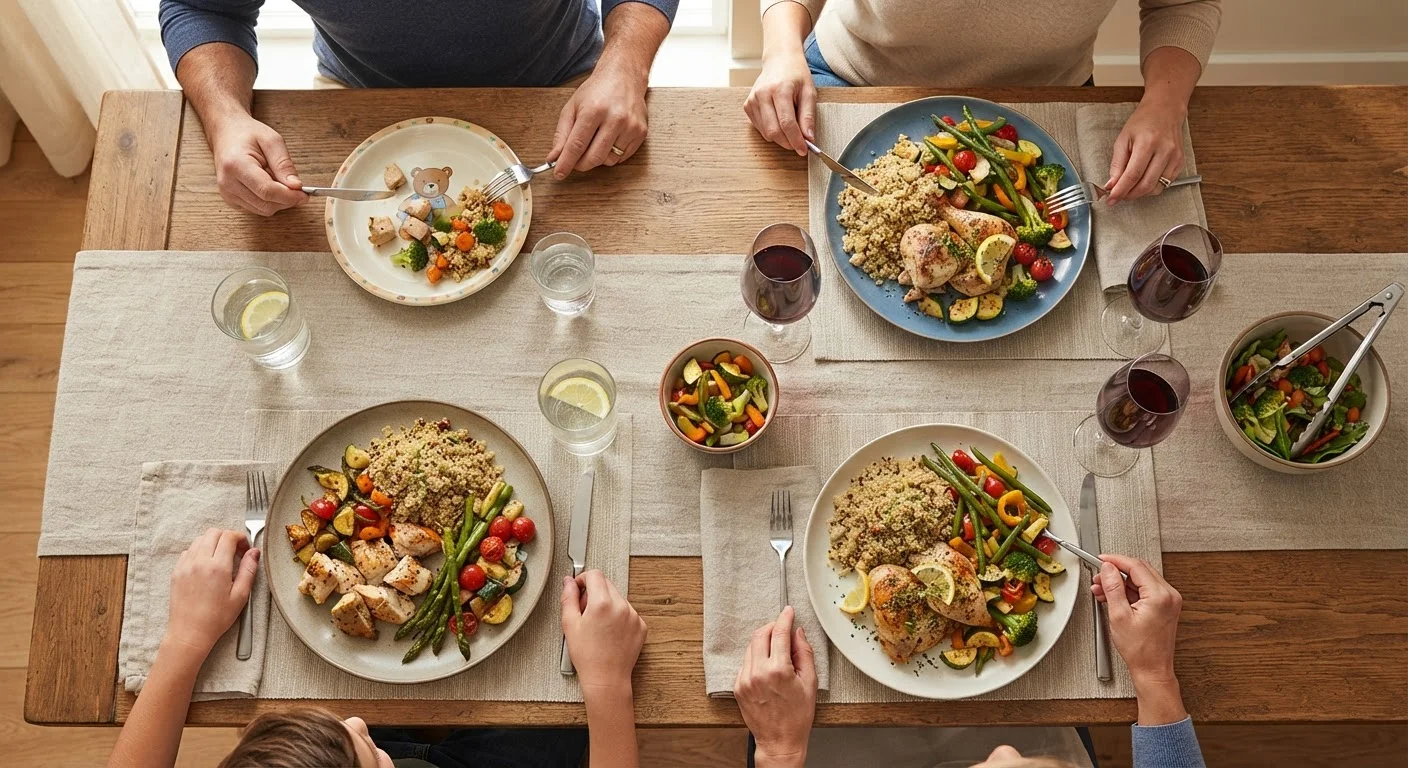
Key Takeaways
- Energy needs vary widely across age groups — a teen athlete may need twice the calories of a young child.
- Cooking one shared meal and adjusting serving amounts is nutritionally sound and budget-friendly.
- Visual portion cues, like using the hand or plate divisions, help families serve appropriately without weighing food.
- Children are generally reliable hunger signals when pressure and distraction are minimized at mealtimes.
- Older adults often need smaller portions but higher nutrient density — quality matters as much as quantity.
- Consulting a registered dietitian is recommended for family members with specific health conditions or growth concerns.
Portion Sizing for Mixed-Age Households
Portion sizing for mixed-age households is the practice of adjusting the amount of food served to each family member based on their age, size, and energy needs — while cooking one shared meal. Rather than preparing separate dishes, the same foods are served in different quantities appropriate to each person. This approach acknowledges that a toddler, a teenager, and an older adult sitting at the same table have fundamentally different caloric and nutrient requirements.
Energy requirements are expressed in kilocalories (kcal) and vary significantly by age, sex, and activity level; the USDA Dietary Guidelines for Americans provide age-grouped reference values that can guide household portioning decisions.
Why Age Makes Such a Big Difference at the Dinner Table
Energy needs don't move in a straight line across a lifetime. A sedentary older adult may require roughly 1,600–1,800 kcal per day, while an active teenage boy in a growth phase may need upward of 2,800–3,200 kcal — from the same table, eating the same foods. Understanding this range is the foundation of smart household portioning.
For a fuller picture of each family member's specific nutritional requirements by life stage, our reference guide to nutritional needs across the family table walks through what toddlers, school-age children, teens, adults, and older family members each need.
The practical takeaway: the gap between the smallest and largest eater in a mixed-age household is often larger than families assume, and it shifts constantly as children grow.
~2x
Calorie gap between young child and active teen
USDA Dietary Guidelines for Americans reference intakes show active teenage boys may need roughly double the daily calories of a preschool-age child.
~30%
Decline in caloric need from young adult to older adult
Energy requirements typically decrease by roughly 20–30% between young adulthood and age 70+, according to established dietary reference values.
1 in 3
Older adults at risk of inadequate protein intake
Studies in nutrition science suggest a significant proportion of adults over 65 consume less protein than recommended to maintain muscle mass.
A Practical Framework for Adjusting Portions Without Extra Cooking
The most family-friendly approach is to cook one nutritionally complete meal and adjust the volume served to each person — not the foods themselves. This keeps mealtimes simple and avoids communicating that different family members require entirely separate treatment.
Use the Plate Division Model
A widely used visual guide suggests filling roughly half the plate with vegetables and fruit, a quarter with whole grains or starchy foods, and a quarter with protein. This proportion works across age groups — only the total plate size changes. A younger child's plate is simply smaller; a teenager's is larger.
Serve Family-Style When Possible
Placing food in shared serving dishes lets each person take an age-appropriate amount guided by their own hunger. Research on child feeding suggests that children are generally capable of self-regulating intake when they are not pressured to eat specific amounts. Strategies for navigating picky eating can complement this approach for younger children who resist variety.
Anchor Protein Portions Deliberately
Protein is one area where deliberate portioning pays off. Older adults benefit from maintaining adequate protein intake to preserve muscle mass, even as overall caloric needs decline. A portion of protein roughly the size of the palm is a common visual guide that scales with body size across family members.
Use Hands as a Portable Portion Guide
Because hands scale roughly with body size, they make a practical visual tool across age groups. A child's palm for protein, a cupped hand for grains, and two open hands for vegetables gives age-appropriate portions without any measuring equipment. This isn't a clinical tool, but it helps establish reasonable habits at the table.
Special Considerations for Older Adults and Young Children
At both ends of the age spectrum, portion sizing requires a little more attention. Young children have small stomachs and benefit from smaller, more frequent eating occasions — something thoughtful snack planning can support alongside main meals.
Older adults present a different challenge: appetite often decreases with age, but nutritional needs remain substantial. If a grandparent or aging parent consistently eats very small amounts, it's worth assessing whether their diet is meeting nutritional requirements. A household nutrition check for aging family members offers a useful starting framework for that conversation. Similarly, meal planning for adults with changing appetites addresses how to maintain nutrition when appetite is unreliable.
Batch Cooking Can Simplify Portion Flexibility
Preparing larger quantities of base ingredients — grains, roasted vegetables, cooked proteins — makes it easier to adjust individual portions at serving time. Batch cooking strategies for families can reduce weeknight stress while keeping flexible portioning practical.
This article is for general informational purposes only and is not a substitute for personalized medical or dietary advice. Consult a registered dietitian or qualified healthcare professional for guidance specific to your family members' health conditions, growth stages, or medical needs.