

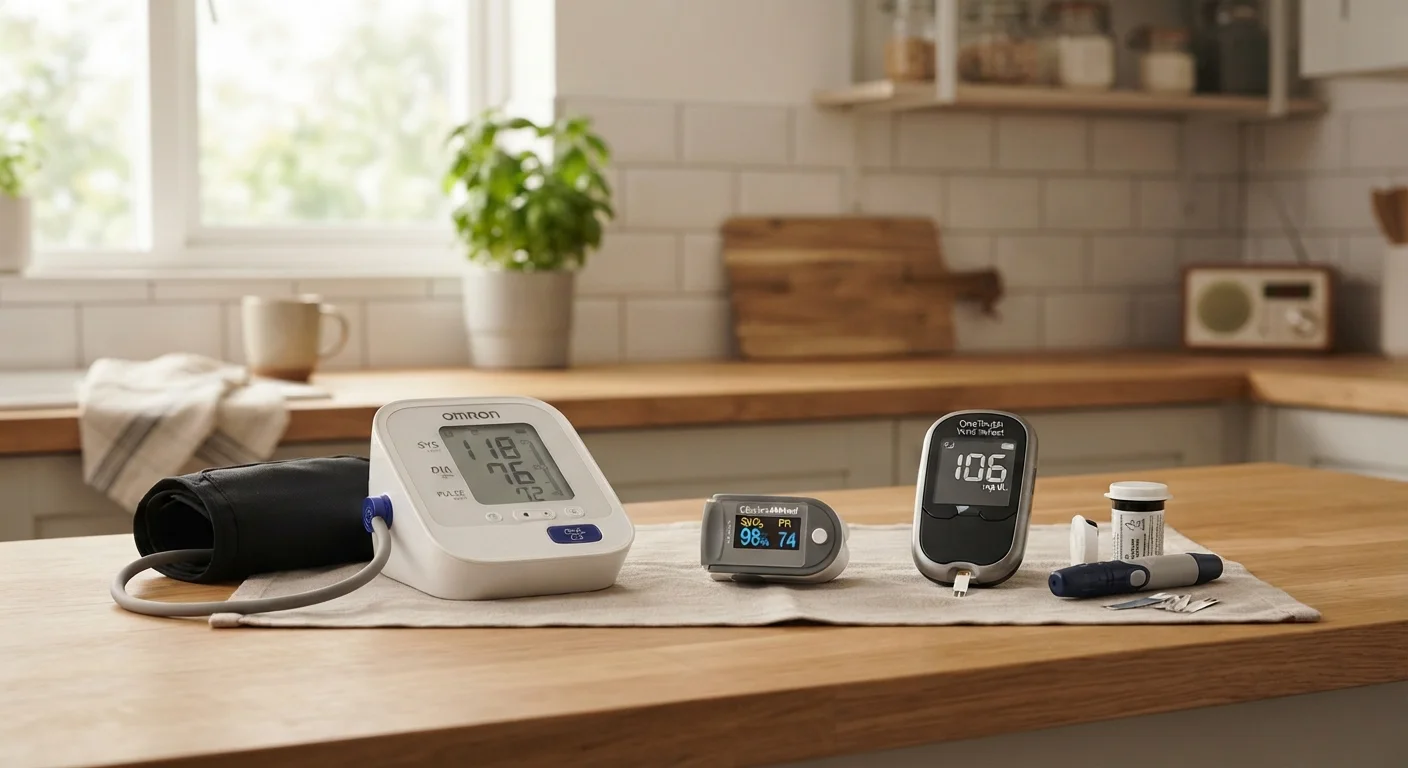
Key Takeaways
- Home health monitors track specific vital signs between clinical visits — they do not diagnose conditions.
- Blood pressure monitors, glucose meters, and pulse oximeters each measure a different and distinct health metric.
- A single reading is rarely enough; consistent patterns over time are what matter most to clinicians.
- All home monitors require correct technique to produce reliable results.
- Home monitoring supports — but never replaces — professional medical care.
Start here
What Home Health Monitors Actually Do
Core device #1
Blood Pressure Monitors: The Basics
Core device #2
Glucose Monitors: Tracking Blood Sugar at Home
Core device #3
Pulse Oximeters: Measuring Oxygen in the Blood
Apply your knowledge
When to Use Home Monitors — and When to Call a Doctor
What Home Health Monitors Actually Do
Home health monitoring devices measure specific physiological signals — such as blood pressure, blood glucose, or blood oxygen level — and display the result for the user. They do not diagnose illnesses or replace clinical testing. Think of them as a way to collect useful data between doctor's visits, giving both families and healthcare providers a clearer picture of how a person's body is functioning day to day.
The U.S. Food and Drug Administration (FDA) classifies most home monitors as medical devices and requires manufacturers to meet defined performance standards before selling them. Devices that carry a label indicating they are "clinically validated" have been tested against reference standards in human subjects. Understanding this distinction matters — not all monitors on the market have been validated to the same standard.
For an accessible explanation of the terms and units you'll encounter on these devices, see our plain-language glossary of home monitor terms.
Systolic pressure
The higher number in a blood pressure reading, representing the pressure in your arteries when your heart contracts and pumps blood.
Diastolic pressure
The lower number in a blood pressure reading, representing the pressure in your arteries when your heart rests between beats.
Blood glucose
The concentration of sugar (glucose) in the bloodstream, typically measured in mg/dL. It rises after eating and is regulated by insulin.
SpO2
Peripheral oxygen saturation — the estimated percentage of hemoglobin molecules in the blood that are carrying oxygen, measured non-invasively by a pulse oximeter.
Clinically validated
A device that has been tested in human subjects against a recognized reference standard and shown to meet defined accuracy criteria.
Interstitial fluid
The fluid that surrounds cells in body tissue, just beneath the skin. Continuous glucose monitors measure glucose levels in this fluid rather than directly in the blood.
Blood Pressure Monitors: The Basics
A home blood pressure monitor — also called a sphygmomanometer (sfig-moh-muh-NOM-ih-ter) — measures the force of blood against the walls of your arteries. It produces two numbers: systolic pressure (the pressure when your heart beats) over diastolic pressure (the pressure between beats), expressed in millimeters of mercury, or mmHg.
Upper-arm cuff models are generally considered more accurate than wrist-style monitors for most adults, and are commonly recommended by clinical guidelines. Proper positioning is critical: the cuff must be snug at heart level, and the person should be seated and rested for at least five minutes before measuring.
Because blood pressure naturally fluctuates throughout the day, a single reading provides limited information. Clinicians typically look for consistent patterns across multiple readings taken at similar times. Our guide on building a home monitoring routine explains how to log and share readings effectively.
Take multiple readings, not just one
Most clinical guidelines suggest taking two or three blood pressure readings one to two minutes apart and averaging the results. A single measurement can be skewed by recent activity, stress, caffeine, or talking during the reading. Consistent patterns across multiple sessions are far more meaningful than any individual number.
Glucose Monitors: Tracking Blood Sugar at Home
A glucose monitor (also called a glucometer) measures the concentration of glucose in a small blood sample, usually obtained from a fingertip. The result is displayed in milligrams per deciliter (mg/dL) in the United States. This measurement helps people with diabetes — and their care teams — understand how food, activity, medication, and illness affect blood sugar levels.
Traditional finger-prick glucometers require a lancet, a test strip, and a drop of blood. Continuous glucose monitors (CGMs) take a different approach, using a small sensor inserted just under the skin to measure glucose in interstitial fluid at regular intervals without repeated finger-pricks. Both approaches have distinct use cases — our article on CGMs vs. finger-prick glucometers covers the trade-offs clearly.
If your family is new to using a glucometer, our step-by-step walkthrough on setting up a home glucose monitor for the first time covers calibration and safe test strip handling.
Pulse Oximeters: Measuring Oxygen in the Blood
A pulse oximeter is a small clip-on device, usually worn on a fingertip, that estimates the percentage of oxygen-carrying hemoglobin in the blood — a value called SpO2 (peripheral oxygen saturation). It works by shining two wavelengths of light through the skin and measuring how much is absorbed; oxygenated and deoxygenated blood absorb light differently, allowing the sensor to calculate a ratio.
Pulse oximeters also display pulse rate. For most healthy adults, an SpO2 reading of 95% or above is within the normal range, though clinical interpretation depends on individual health context. Cold fingers, nail polish, and poor circulation can affect accuracy.
It is worth noting that research has identified variability in pulse oximeter accuracy across different skin tones. The FDA has acknowledged this issue and has called for improved device testing standards. Families should discuss this with a healthcare provider if it is relevant to their situation.
Pulse oximeters are not diagnostic tools
A pulse oximeter reading alone cannot diagnose respiratory conditions, heart disease, or COVID-19. If someone shows symptoms such as difficulty breathing, confusion, or persistent low readings, seek medical attention promptly rather than relying solely on the device. Always use oximeter data in conversation with a healthcare provider.
When to Use Home Monitors — and When to Call a Doctor
Home monitors are most useful when they are part of an ongoing, structured approach to health tracking — not just used in moments of anxiety. Common scenarios where they add genuine value include managing a diagnosed condition (such as hypertension or diabetes), following up after a clinical visit, or tracking recovery from an illness under a doctor's guidance.
What they are not suited for: making diagnoses, replacing scheduled medical appointments, or serving as the sole basis for changing a treatment plan. Always share your home monitoring data with your healthcare provider so readings can be interpreted in the full context of your health history.
For a broader look at how home monitors fit alongside other at-home tools, see our overview of at-home diagnostic tools for families. And to avoid common mistakes that can skew results, check out our coverage of home monitoring myths families should stop believing.
This article provides general health information for educational purposes only and is not a substitute for professional medical advice, diagnosis, or treatment. Always consult a qualified healthcare provider with questions about your health or before making any changes to your care.