

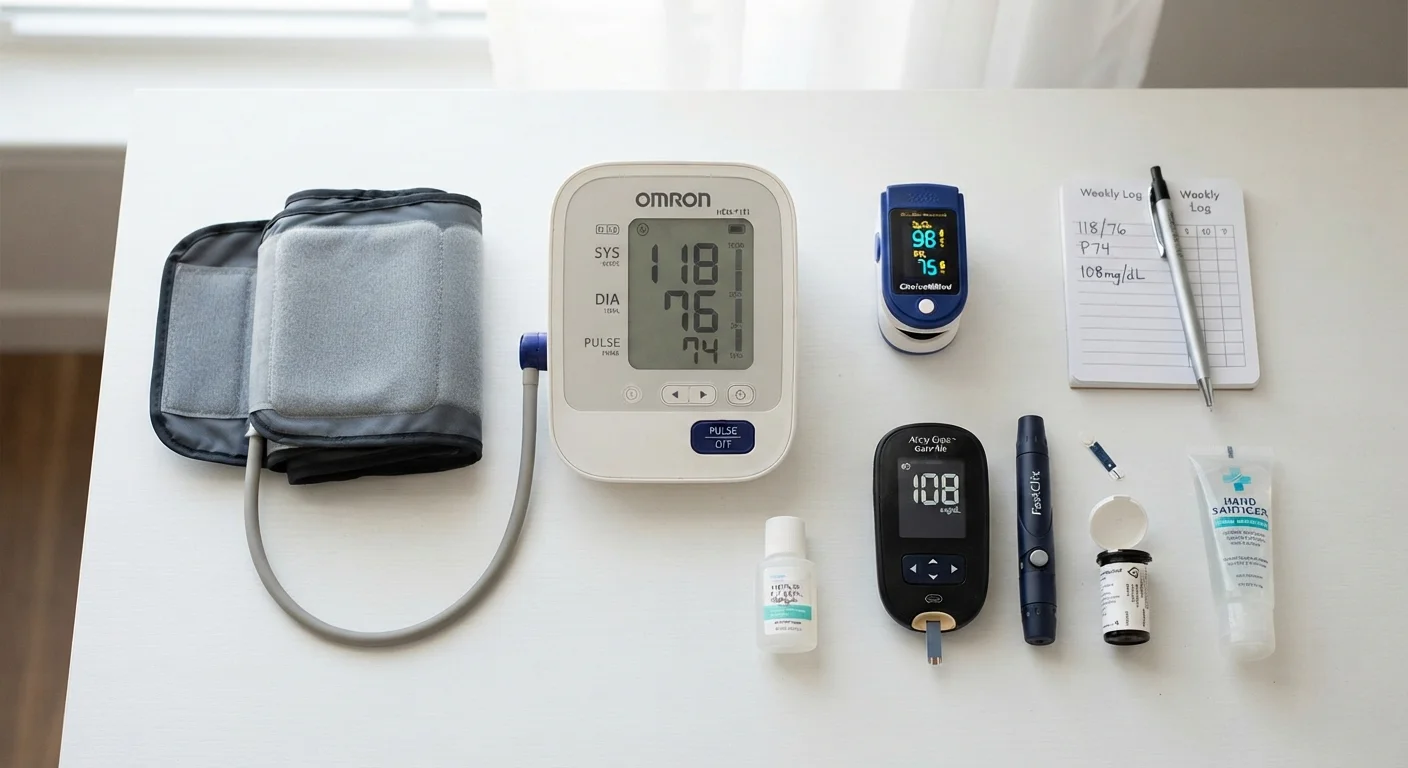
| Standard blood pressure unit | mmHg (millimetres of mercury) |
| US blood glucose unit | mg/dL (milligrams per decilitre) |
| SpO2 measurement method | Non-invasive light absorption through skin |
| HbA1c reflects glucose over | Approximately 2–3 months (Established clinical reference) |
| mg/dL to mmol/L conversion | Divide mg/dL by 18 |
| Irregular heartbeat flags | Require clinician review; not a standalone diagnosis |
Why These Terms Matter
Home health monitors display abbreviations, units, and values that can feel cryptic without a reference point. Misreading a number — or misunderstanding what it measures — can lead to unnecessary worry or, in the other direction, false reassurance. This glossary covers the most common terms families encounter across blood pressure monitors, pulse oximeters, and blood glucose meters.
If you are new to home monitoring, A Family's First Guide to Home Health Monitoring Devices provides a helpful starting point before diving into the terminology below.
This article is for general informational purposes only and is not a substitute for professional medical advice. Always consult a qualified healthcare provider about your specific readings and health needs.
| Standard blood pressure unit | mmHg (millimetres of mercury) |
| US blood glucose unit | mg/dL (milligrams per decilitre) |
| SpO2 measurement method | Non-invasive light absorption through skin |
| HbA1c reflects glucose over | Approximately 2–3 months (Established clinical reference) |
| mg/dL to mmol/L conversion | Divide mg/dL by 18 |
| Irregular heartbeat flags | Require clinician review; not a standalone diagnosis |
Blood Pressure Terms
Blood pressure monitors produce more data than just two numbers. Here is what each element means:
- Systolic pressure — the upper number, measured in mmHg, representing the force in your arteries when your heart beats.
- Diastolic pressure — the lower number, representing arterial pressure between heartbeats.
- mmHg — millimetres of mercury, the universal unit for blood pressure measurement. It is a legacy unit retained because clinical thresholds worldwide are defined in mmHg.
- Pulse pressure — the arithmetic difference between systolic and diastolic values. Some monitors display this automatically; others require you to calculate it manually.
- Irregular heartbeat indicator (IHB/AFib symbol) — a flag some monitors display when they detect an irregular rhythm during measurement. A single flag does not confirm a clinical arrhythmia; it signals that the reading should be discussed with a clinician.
- Average mode — a feature that takes two or three consecutive readings and displays their mean, reducing the effect of any single outlier.
For a deeper explanation of blood pressure readings, see Blood Pressure Monitors at Home: What the Numbers Actually Mean.
mmHg
Millimetres of mercury — the standard unit for measuring blood pressure. Clinical guidelines worldwide express blood pressure thresholds in mmHg, making it essential for interpreting monitor readings.
SpO2
Peripheral oxygen saturation — the estimated percentage of haemoglobin carrying oxygen, measured non-invasively by a pulse oximeter. Values are a useful indicator but can be affected by sensor placement, movement, and skin perfusion.
HbA1c
Glycated haemoglobin — a blood marker reflecting average glucose levels over approximately two to three months. It is used clinically to monitor long-term glucose management, and some home devices now provide estimated values.
Systolic pressure
The higher of the two blood pressure values, recorded in mmHg. It represents the pressure in the arteries at the moment the heart contracts and pumps blood.
Diastolic pressure
The lower blood pressure value, recorded in mmHg. It measures arterial pressure during the resting phase between heartbeats.
Perfusion index (PI)
A ratio, displayed on some pulse oximeters, indicating how strong the pulse signal is at the measurement site. A low PI can reduce reading reliability and may call for repositioning the sensor.
mg/dL
Milligrams per decilitre — the US standard unit for blood glucose concentration. Results from home glucose meters in the United States are reported in mg/dL.
Reference range
The span of values considered within normal limits by established clinical guidelines. Reference ranges are derived from population studies and serve as a general benchmark, not an individual diagnosis.
Control solution
A liquid with a precisely known glucose concentration supplied with many glucose meters. Running a control test confirms the meter and test strips are producing accurate results before using them on a person.
Calibration
The alignment of a device's measurement output to a verified reference standard. Consumer monitors are typically factory-calibrated, but some devices or strips require periodic checks to maintain accuracy.
Pulse Oximetry and Glucose Terms
Pulse oximeters and blood glucose meters each carry their own vocabulary.
Pulse Oximetry
- SpO2 — peripheral oxygen saturation, expressed as a percentage. It estimates the proportion of haemoglobin in your blood that is carrying oxygen, measured non-invasively through the skin.
- Pulse rate — beats per minute (bpm) as detected by the oximeter. This is the same value as heart rate when measured this way, though the two terms are sometimes used interchangeably.
- Perfusion index (PI) — a measure of the strength of the pulse signal at the sensor site, expressed as a percentage. A very low PI may mean the reading is less reliable.
- Plethysmograph waveform — the pulsing graph displayed on some oximeters showing each heartbeat. A smooth, regular wave suggests a reliable signal.
Blood Glucose
- mg/dL — milligrams per decilitre, the unit used in the United States for blood glucose values.
- mmol/L — millimoles per litre, used in many other countries. A single conversion factor (divide mg/dL by 18) moves between the two.
- HbA1c — glycated haemoglobin, a measure of average blood glucose over approximately two to three months. Some home devices now estimate this value; clinical lab testing remains the reference standard.
- Control solution — a liquid with a known glucose concentration used to verify that a glucose meter and its test strips are functioning correctly before testing.
- Test strip coding — older meters require you to enter a code printed on the strip vial so the device calibrates to that batch. Many current meters use auto-coding strips.
Before logging any reading, review Before You Log That Reading: A Home Monitor Accuracy Checklist to confirm technique and device conditions are sound.
General Device and Display Terms
Across device types, several terms appear repeatedly:
- Calibration — the process of aligning a device's measurements to a known reference standard. Most consumer monitors are factory-calibrated; some require periodic recalibration.
- Memory / recall — storage of previous readings on the device, often with date and time stamps. This feature supports trend tracking and sharing data with a clinician.
- Reference range — the span of values considered typical by clinical guidelines. Reference ranges are population-derived and do not automatically define what is normal for a specific individual.
- Error code — a numeric or alphabetic flag the device displays when a reading cannot be completed reliably — for example, due to movement, poor cuff fit, or a depleted test strip.
For a broader look at diagnostic device terminology beyond monitoring, Key Terms on Every At-Home Diagnostic Device: A Family Reference covers concepts such as sensitivity, specificity, and reference intervals in plain language.
Once you are comfortable with the terminology, Home Health Monitoring: Building a Routine That's Actually Useful explains how to time readings and share results effectively with your healthcare team.