

| Sensitivity vs. Specificity | High sensitivity = fewer missed cases; High specificity = fewer false alarms |
| Common qualitative test types | Rapid antigen, pregnancy, strep, UTI dipstick |
| Common quantitative test types | Blood glucose, blood pressure, pulse oximetry, thermometry |
| Key calibration check | Run QC solution when opening a new consumable batch |
| Invalid result indicator | Missing control line on a lateral flow test |
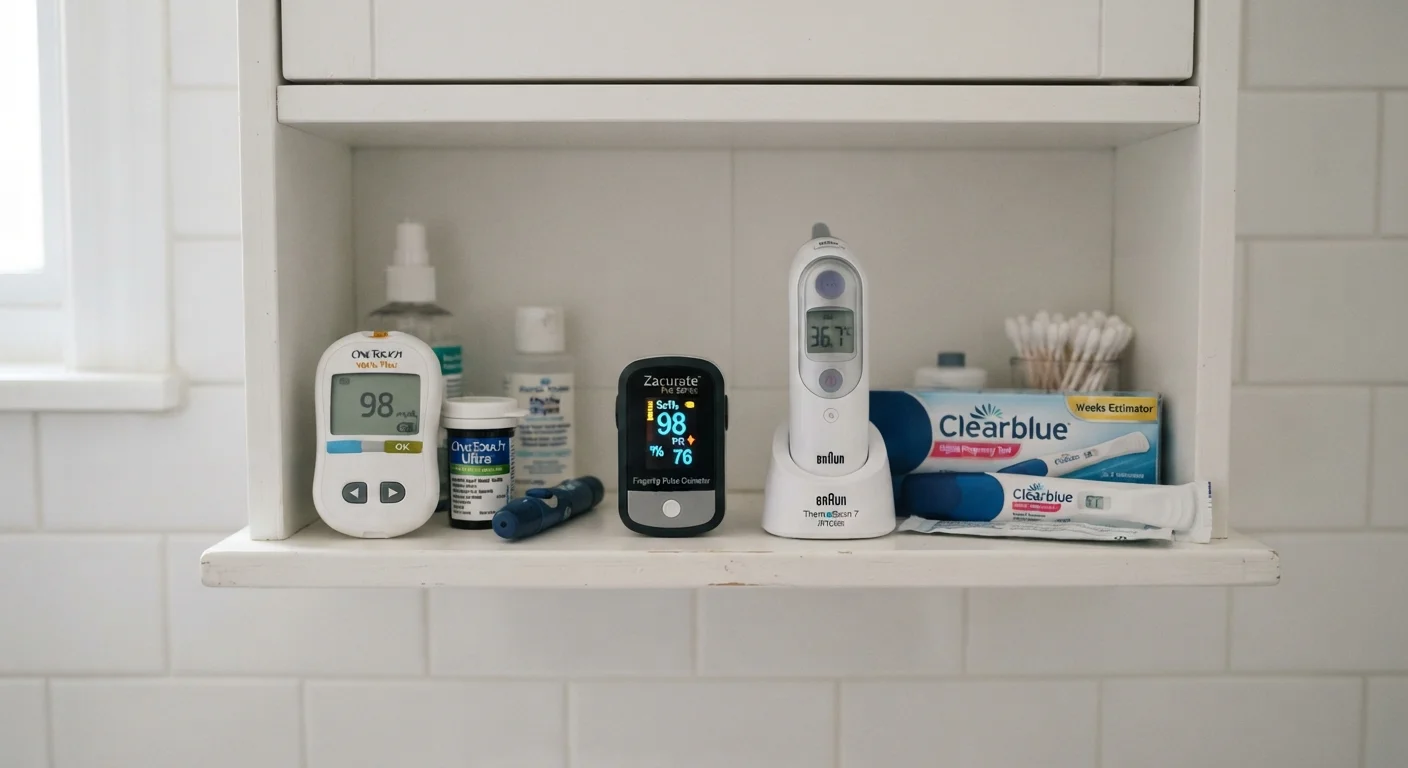
| Strip storage caution | Avoid bathrooms and direct sunlight; follow package humidity guidelines |
Why Device Terminology Matters
At-home diagnostic devices — from blood glucose meters to rapid antigen tests — come with labels, instructions, and result displays packed with technical language. Misreading a term like sensitivity or reference range can lead a family to either dismiss a result that warrants follow-up or to worry unnecessarily about a normal reading.
This reference covers the core terms you are most likely to encounter across home diagnostic tools, organized by category. It is intended as general health education, not medical advice. Always consult a qualified healthcare professional when interpreting results that concern you.
For a broader introduction to how these devices work before diving into terminology, see our guide to at-home diagnostic tools. Families with members at different life stages may also find value in our article on diagnostic tools across the lifespan.
Sensitivity
A measure of a test's ability to correctly identify people who have a condition (true positive rate). High sensitivity means fewer cases are missed. Expressed as a percentage.
Specificity
A measure of a test's ability to correctly identify people who do not have a condition (true negative rate). High specificity means fewer false alarms. Expressed as a percentage.
Reference Range
The span of values considered normal for a healthy population group. Values outside this range may require clinical evaluation but do not alone confirm a diagnosis.
Calibration
The process of standardizing a device against a known reference to ensure measurement accuracy. Some home devices require manual calibration; others perform it automatically.
False Positive
A test result that indicates a condition is present when it actually is not. Can cause unnecessary anxiety or unnecessary follow-up testing.
False Negative
A test result that indicates a condition is absent when it is actually present. Can lead to delayed care if symptoms are dismissed based solely on the result.
Qualitative Result
A result expressed as a category, such as positive or negative, rather than a number. Common in rapid antigen tests and home pregnancy tests.
Quantitative Result
A result expressed as a specific numeric measurement with units, such as blood glucose in mg/dL. Quantitative results support trend monitoring over time.
Limit of Detection
The smallest amount of a substance a device can reliably identify. Samples with lower concentrations may produce negative results even when the substance is technically present.
Control Line
A built-in indicator on lateral flow tests that confirms the test was performed correctly. An absent control line means the result is invalid and the test should be repeated.
Quality Control Solution
A liquid with a pre-set known value used to verify a device and its consumables are functioning within acceptable accuracy ranges before use on a patient sample.
Precision
The degree to which a device produces the same result when measuring the same sample repeatedly. Precision and accuracy are related but distinct — a precise device is not necessarily accurate.
Accuracy and Performance Terms
These terms describe how reliably a device detects or measures what it claims to measure. You will encounter them most often in device manuals, package inserts, and regulatory documentation.
| Sensitivity vs. Specificity | High sensitivity = fewer missed cases; High specificity = fewer false alarms |
| Common qualitative test types | Rapid antigen, pregnancy, strep, UTI dipstick |
| Common quantitative test types | Blood glucose, blood pressure, pulse oximetry, thermometry |
| Key calibration check | Run QC solution when opening a new consumable batch |
| Invalid result indicator | Missing control line on a lateral flow test |
| Strip storage caution | Avoid bathrooms and direct sunlight; follow package humidity guidelines |
- Sensitivity: The ability of a test to correctly identify positive cases. A test with high sensitivity rarely misses true positives (e.g., a rapid flu test that detects most actual flu infections). A false negative occurs when a positive case is missed.
- Specificity: The ability of a test to correctly identify negative cases — people who do not have the condition. High specificity means few false positives. A false positive occurs when the device indicates a condition that is not actually present.
- Accuracy: An overall measure of how often the device produces a correct result across both positive and negative cases. No device is 100% accurate.
- Precision (Reproducibility): Whether the device gives consistent results when the same sample or condition is measured multiple times under the same conditions. A device can be precise but not accurate — giving the same wrong answer repeatedly.
- Limit of Detection (LoD): The lowest concentration of a substance (such as a pathogen or glucose) that a device can reliably detect. Results below this threshold may read negative even when a small amount is present.
Result and Reference Terms
These are the terms most directly relevant to reading and understanding what a device is telling you.
- Reference Range (Normal Range): The set of values considered typical for a healthy population. Results outside this range may warrant follow-up but do not automatically confirm disease. Reference ranges can vary by age, sex, and the specific device used.
- Qualitative Result: A result expressed as a category rather than a number — most commonly positive/negative or detected/not detected. Rapid antigen tests and pregnancy tests produce qualitative results.
- Quantitative Result: A result expressed as a specific numeric value with units (e.g., 98 mg/dL for blood glucose). Quantitative results allow tracking trends over time.
- Control Line / Control Band: A built-in indicator on lateral flow tests (such as rapid antigen tests) that confirms the test ran correctly. If the control line does not appear, the result is invalid regardless of what the test line shows.
- Error Code: A device-generated notification indicating a malfunction, an out-of-range reading, or an improper sample. Consult the device manual for each specific error code meaning.
For an in-depth look at specific values like mmHg, SpO2, and HbA1c on monitoring devices, our glossary of home monitor terms covers those in detail.
Device Operation and Maintenance Terms
Proper use and upkeep directly affect result reliability. These terms appear in setup guides and maintenance sections of device manuals.
- Calibration: The process of adjusting or verifying a device against a known standard to ensure its measurements are accurate. Some devices self-calibrate; others require periodic manual calibration or calibration solutions.
- Calibration Code / Coding: A code entered into a glucose meter (or similar device) that matches the meter's settings to a specific batch of test strips. Using the wrong code can produce inaccurate readings. Many modern meters auto-code.
- Quality Control (QC) Solution: A liquid with a known concentration used to verify that a device and its test strips are working correctly. Running QC checks periodically — and whenever you open a new strip vial — is standard practice.
- Expiration Date: The date after which a test strip, cartridge, or lateral flow test can no longer be guaranteed to perform within its validated accuracy range. Using expired consumables is a common source of inaccurate results.
- Storage Conditions: Temperature and humidity requirements for storing test strips or device components. Most strips should not be stored in bathrooms due to humidity, nor in direct sunlight.
Families using home monitoring devices such as blood pressure cuffs or pulse oximeters will encounter many of these same operational terms.
This article is for general informational purposes only and does not constitute medical advice. Consult a qualified healthcare professional before making any health decisions based on at-home diagnostic results.