
At-Home Diagnostic Tools Across the Lifespan: Infants, Adults, and Older Adults

Key Takeaways
- Accuracy of home diagnostic devices can vary meaningfully depending on the user's age and physiology.
- Infant temperature measurement requires age-appropriate methods; rectal thermometry remains the most accurate for newborns.
- Adults benefit most from consistent technique and regular device calibration to ensure reliable readings.
- Older adults may face unique challenges including medication effects and peripheral circulation changes that affect device accuracy.
- No home diagnostic result should replace clinical evaluation for concerning or persistent symptoms.
Why Age Changes How Devices Perform
At-home diagnostic tools are designed to measure specific physiological signals — body temperature, blood oxygen saturation, blood pressure, or the presence of certain biomarkers. The accuracy and appropriate use of these devices, however, are not one-size-fits-all. Physiological differences across the lifespan directly affect how devices should be used and how results should be interpreted.
For example, the size and structure of a child's ear canal differs from an adult's, which affects the performance of tympanic (ear) thermometers. Similarly, peripheral circulation — the blood flow to the hands and feet — tends to decline with age, which can influence pulse oximeter (a device that measures blood oxygen levels) readings in older adults. Understanding these nuances helps families use their devices more confidently and avoid acting on misleading readings.
For a plain-language explanation of terms such as reference range, sensitivity, and calibration that appear on device packaging and instructions, see the family reference glossary covering common at-home diagnostic device terms.
Always Read the Age Range on Device Packaging
Most home diagnostic devices specify the age range they are validated for. Using a device outside its indicated age range — such as an adult blood pressure cuff on a child — can produce inaccurate results that may lead to unnecessary concern or, more dangerously, false reassurance. Check the instructions for use before deploying any device on a new family member.
Diagnostic Tools for Infants and Young Children
Accurate temperature measurement is one of the most common reasons families use diagnostic tools for infants. The American Academy of Pediatrics (AAP) has historically recommended rectal thermometry as the most accurate method for newborns and infants under three months, because even small temperature variations can signal serious illness requiring urgent medical attention in this age group.
Temporal artery thermometers (forehead-scanning devices) and tympanic thermometers are generally considered more appropriate for children over six months, once the ear canal has developed sufficiently. Oral thermometers are typically suitable once a child can hold one safely under the tongue, usually around age four or five.
Pulse oximeters designed for adults are not calibrated for infants and should not be used on small fingers or toes without a pediatric-specific probe. Hospital-grade pediatric pulse oximetry probes are sized and calibrated differently from consumer adult devices.
Fever in Newborns Requires Immediate Medical Attention
Any temperature of 100.4°F (38°C) or higher in an infant under three months is considered a medical emergency by most clinical guidelines. Do not wait to see if it resolves — contact a healthcare provider or go to an emergency department immediately. Home thermometer readings in this age group should always be communicated to a clinician promptly.
Always consult a pediatrician about which specific devices are appropriate for your child's age and any existing health conditions. For guidance on routine checkups that complement home monitoring, visit the screenings and checkups hub.
At-Home Testing for Adults
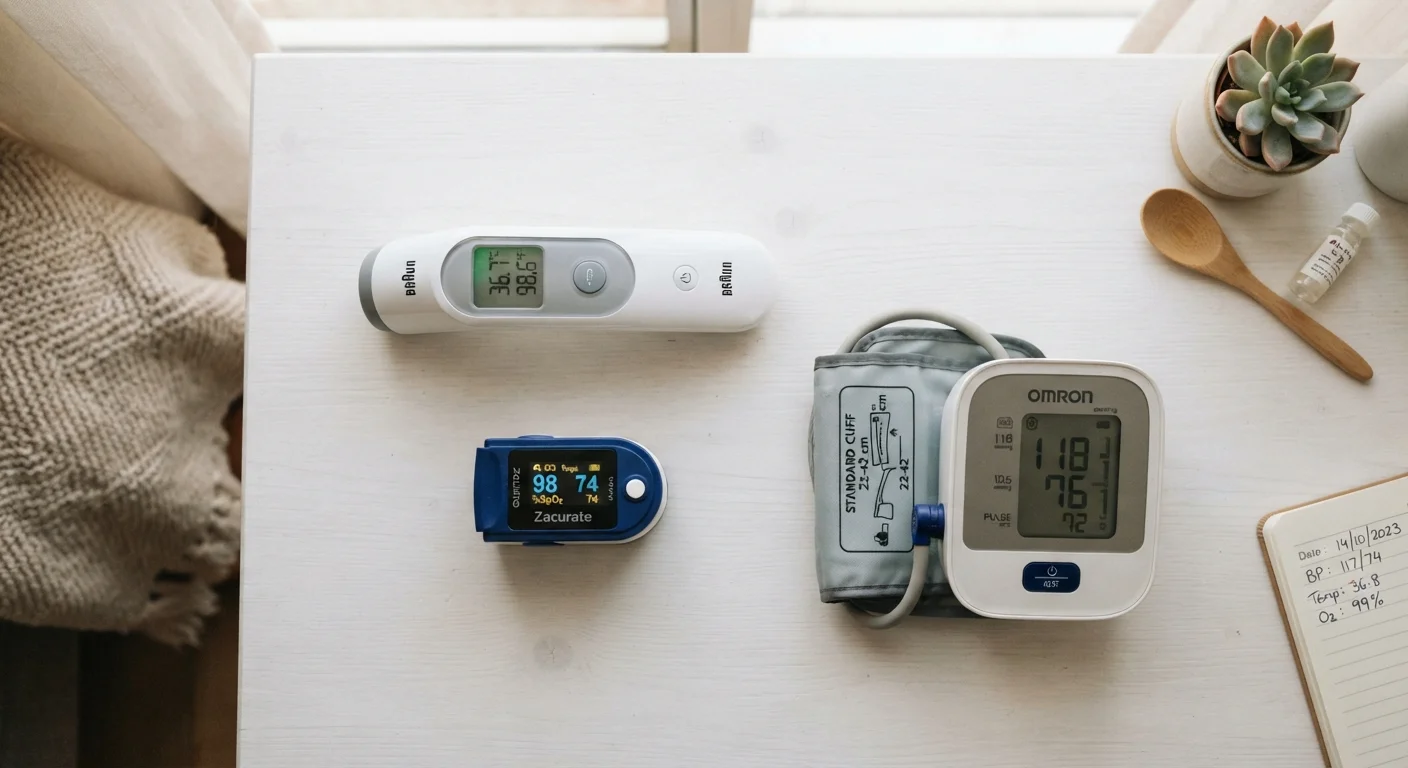
Adults have the widest range of available home diagnostic options, from blood pressure monitors and glucose meters to rapid antigen tests and fertility trackers. Proper technique is the single most important factor in obtaining reliable readings.
Blood pressure monitors, for instance, require the cuff to be sized correctly for the user's arm circumference. A cuff that is too small will produce falsely elevated readings, while one that is too large may read low. Positioning — sitting quietly with feet flat on the floor, arm supported at heart level — also significantly affects results.
Glucose meters (used to measure blood sugar levels) require correct lancing technique, adequate sample size, and strips stored within their stated temperature and humidity range. Expired test strips are a common source of inaccurate readings. Adults managing chronic conditions should review home monitoring devices resources for condition-specific guidance.
Take blood pressure readings at the same time each day and log at least three consecutive measurements to establish a reliable baseline — a single reading rarely tells the full story.
Blood pressure fluctuates naturally throughout the day in response to activity, stress, and meals. Consistent timing and multiple readings improve the clinical usefulness of home monitoring data.
Warm your hands for a few minutes before using a fingertip pulse oximeter — cold extremities constrict peripheral blood vessels and are a leading cause of poor signal and inaccurate readings.
Peripheral vasoconstriction reduces the pulsatile blood flow that oximeters rely on to calculate oxygen saturation, and is one of the most commonly cited sources of consumer device error.
For a practical pre-use checklist covering calibration, storage, and technique across device types, see the at-home diagnostic safety checklist.
Special Considerations for Older Adults
Several age-related physiological changes can affect how diagnostic devices perform in older adults. Reduced peripheral circulation — common with age and more pronounced with conditions such as diabetes or heart failure — can cause pulse oximeters to have difficulty obtaining a consistent signal from fingertips, leading to unreliable readings or repeated measurement failures.
Blood pressure measurement in older adults may be affected by a phenomenon called orthostatic hypotension (a drop in blood pressure upon standing), which means readings taken at different times of day or body positions may vary considerably. Some older adults also experience auscultatory gap, a temporary disappearance of sound during manual blood pressure measurement that automated cuffs may misinterpret.
Medication use — particularly diuretics, beta-blockers, and blood thinners — can influence multiple device readings. Families supporting older adults in home monitoring should discuss which devices are appropriate and how to interpret results with the individual's healthcare provider. For families using therapeutic devices alongside diagnostic tools, the article on therapeutic devices for older adults provides relevant safety context.
This article is for informational purposes only and does not constitute medical advice. Always consult a qualified healthcare professional for guidance specific to your family member's health needs.
Interpreting Results and Knowing When to Seek Care
Home diagnostic results are most useful when they are understood in context — not treated as definitive diagnoses. A single abnormal reading does not confirm a condition, and a single normal reading does not rule one out. Families should understand that home devices are screening and monitoring tools, not replacements for clinical evaluation.
Reference ranges printed on device packaging represent population averages and may not account for individual variation, recent physical activity, emotional state, or environmental conditions. Many families misunderstand what a result actually confirms; for a detailed look at accuracy limitations and common errors, see common misconceptions about at-home health tests.
As a general principle, any reading that is significantly outside the normal range, accompanied by symptoms, or unexpectedly different from previous readings warrants a conversation with a healthcare provider. For infants under three months with any fever, for older adults with sudden changes in monitored values, and for anyone experiencing chest pain, difficulty breathing, or altered consciousness — seek emergency care without delay.
This article is for general health information only and is not a substitute for professional medical advice, diagnosis, or treatment. Consult your healthcare provider before making decisions based on home diagnostic readings.