

Key Takeaways
- CGMs measure glucose continuously through interstitial fluid, while glucometers measure blood glucose from a fingertip sample.
- Glucometers generally reflect current blood glucose more immediately; CGMs show trends but may lag by several minutes.
- CGMs carry higher upfront and ongoing costs; glucometers and test strips are widely available and typically less expensive.
- Both device types meet FDA accuracy standards, but technique and calibration affect real-world results.
- The right choice depends on management goals, lifestyle, age, and a healthcare provider's guidance.
Option A
Continuous Glucose Monitor (CGM)
The always-on, trend-aware monitoring solution.
Best for: People who need round-the-clock glucose visibility, including overnight readings and activity-related fluctuations.
Option B
Finger-Prick Glucometer
The proven, straightforward spot-check tool.
Best for: People who need periodic, on-demand glucose readings with a low-cost, widely available device.
If you need 24/7 glucose visibility including sleep and exercise
Continuous Glucose Monitor (CGM)
CGMs automatically record readings every few minutes and alert users to rapid highs or lows, making them well-suited for intensive glucose management.
If you need an affordable, straightforward spot-check option
Finger-Prick Glucometer
Glucometers are widely accessible, require no sensor wear, and give a direct blood glucose reading without subscription or sensor replacement costs.
If managing glucose in a child or older adult with specific care needs
Continuous Glucose Monitor (CGM)
Continuous alerts can help caregivers respond quickly to dangerous glucose swings, though device selection should always involve a healthcare provider.
If verifying or troubleshooting a CGM reading
Finger-Prick Glucometer
Clinical guidelines often recommend confirming unusual CGM readings with a fingerstick before making treatment decisions.
How Each Device Works
Understanding the technology behind each monitor helps clarify why they sometimes produce different numbers — and why that difference matters clinically.
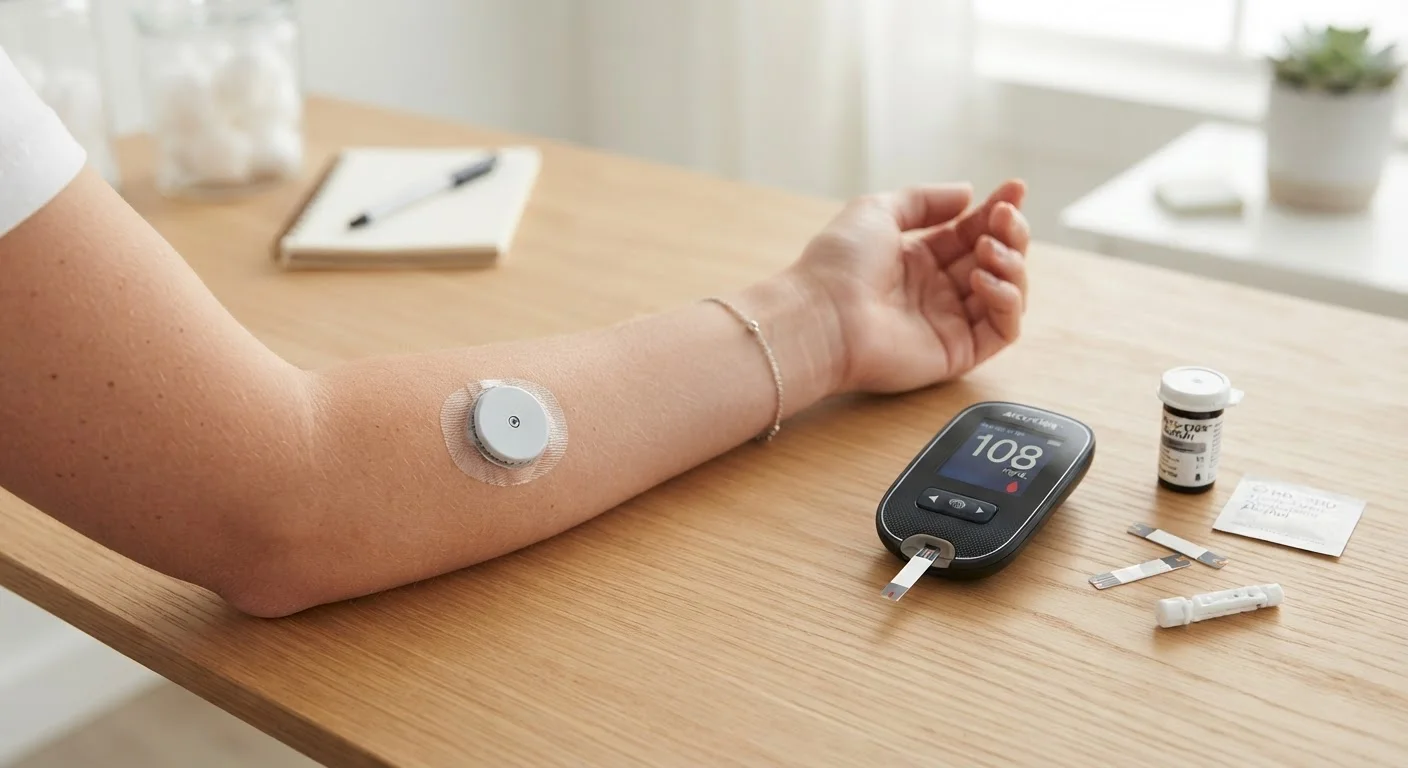
A continuous glucose monitor (CGM) consists of a small sensor inserted just beneath the skin, typically on the abdomen or upper arm. The sensor measures glucose in interstitial fluid — the fluid surrounding cells — rather than in blood directly. A transmitter relays readings wirelessly to a receiver or smartphone app every one to five minutes, producing a real-time graph of glucose trends. Because interstitial glucose lags behind blood glucose by roughly five to fifteen minutes, CGMs are especially powerful for spotting patterns and triggering alerts, but that lag matters during rapid glucose changes.
A finger-prick glucometer works by analyzing a small drop of capillary blood drawn from a fingertip. An electrochemical reaction on the test strip converts glucose concentration into an electrical signal, displaying a result in seconds. This measures blood glucose directly, with no physiological lag. For more on getting accurate results from a glucometer, see our guide to setting up a home glucose monitor.
| Criterion | CGM | Finger-Prick Glucometer |
|---|---|---|
| What it measures | Interstitial fluid glucose | Capillary blood glucose |
| Reading frequency | Every 1–5 minutes, automatically | On demand, per test |
| Physiological lag | 5–15 minute lag possible | Near-immediate reflection |
| Fingersticks required | Minimal or none (varies by device) | Every reading |
| Trend alerts | Yes — high/low alarms available | No automated alerts |
| Typical sensor/strip lifespan | Sensor: 10–14 days | One strip per test |
| Relative cost | Higher upfront and ongoing | Lower device cost; strips ongoing |
| Data output | Continuous graph and trend arrows | Single numeric reading |
Accuracy: What the Evidence Shows
Both CGMs and glucometers must meet FDA accuracy standards, but real-world performance depends on several factors.
The FDA requires glucometers to meet ISO 15197:2013 accuracy criteria: at least 95% of readings must fall within 15 mg/dL of a laboratory reference for values below 100 mg/dL, and within 15% for higher values. CGMs are evaluated differently, often using mean absolute relative difference (MARD) — a lower MARD indicates less deviation from a reference blood glucose value. Modern CGMs from established device categories typically report MARD values in the 9–10% range, though this varies by sensor generation and placement site.
Critically, CGM accuracy can be affected by rapid glucose changes, dehydration, certain medications, and sensor placement. Glucometer accuracy is sensitive to user technique — insufficient blood volume, expired strips, and improper storage are common sources of error. Our home monitor accuracy checklist covers key technique factors that apply to both device types.
~9–10%
Typical MARD for modern CGM sensors
Mean absolute relative difference reflects how closely CGM readings track laboratory reference glucose values across multiple studies.
95%
FDA minimum accuracy threshold for glucometers
Under ISO 15197:2013, at least 95% of glucometer readings must fall within defined margins of a laboratory reference standard.
5–15 min
CGM interstitial fluid lag behind blood glucose
This physiological delay is most clinically significant during rapid glucose rises or falls, such as after meals or exercise.
Because of the interstitial lag, many clinical guidelines advise confirming symptomatic low or high CGM readings with a fingerstick before acting on them — making the two technologies genuinely complementary rather than strictly competing.
Practical Considerations for Families
Beyond technical performance, day-to-day usability and cost shape which device fits a family's situation.
Cost and access: Glucometers themselves are relatively inexpensive, but ongoing test strip costs add up. CGMs involve sensor replacement every 10–14 days (depending on type), a reader or compatible smartphone, and — for some systems — a transmitter. CGMs are generally more expensive overall, though insurance coverage for people with diabetes has expanded in recent years. Families should verify coverage with their insurer and healthcare team.
Comfort and convenience: CGMs eliminate the need for repeated fingersticks and provide passive, continuous data — valuable for active children, overnight monitoring, or anyone with needle sensitivity. However, wearing a sensor continuously and managing app connectivity adds its own complexity. Glucometers require no wearable component and are straightforward to use once technique is established.
Special populations: Age-specific factors significantly influence device selection. Children and older adults may have different sensor placement options, alert thresholds, and caregiver involvement needs. Our article on glucose monitoring in children and older adults outlines what families should discuss with their care team. For a broader introduction to home health monitors, the family's first guide to home health monitoring devices is a useful starting point.
This article is for informational purposes only and is not medical advice. Always consult a qualified healthcare provider before changing how you monitor glucose or making any treatment decisions.