

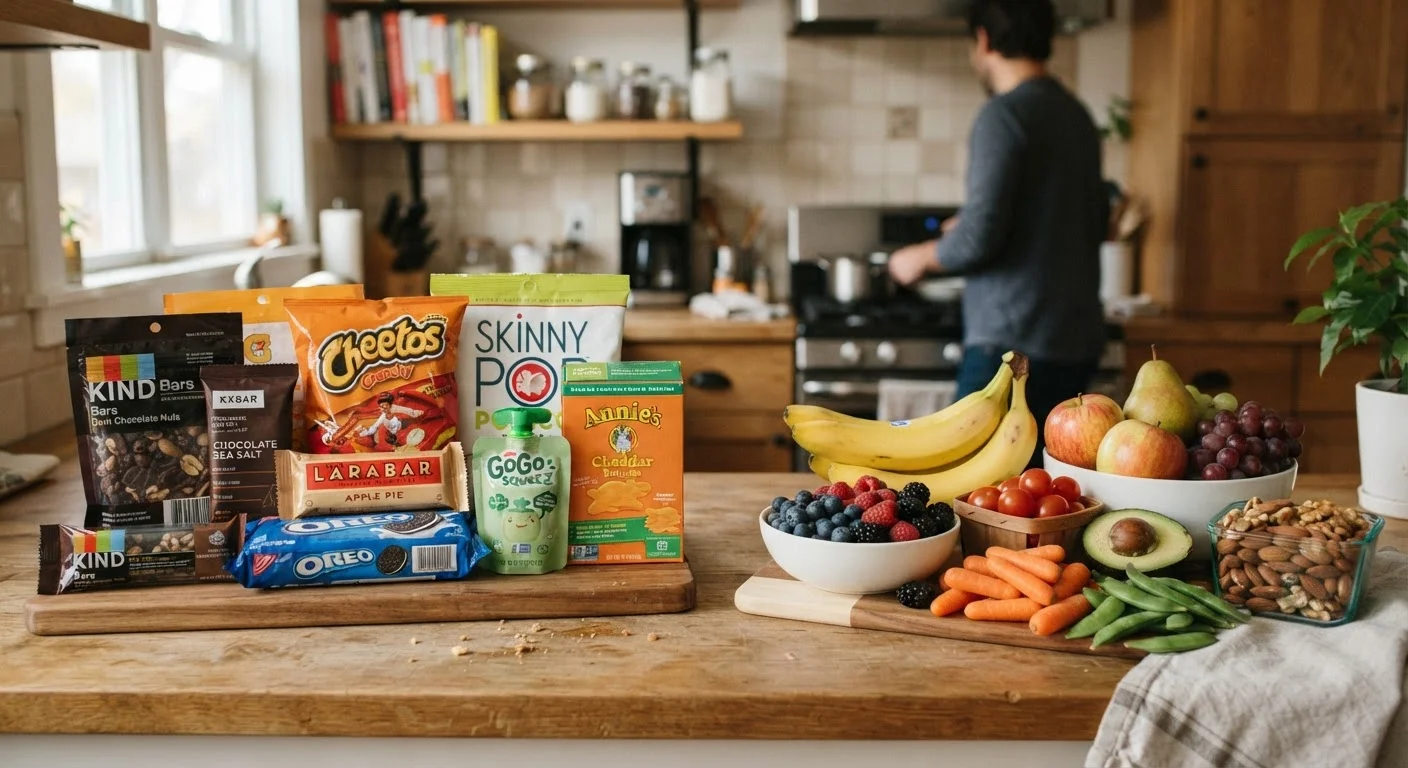
Key Takeaways
- Many foods labeled 'kid-friendly' are high in added sugar, sodium, and refined carbohydrates.
- Marketing terms like 'natural' or 'fortified' do not automatically make a product nutritious.
- Children's palates can adapt to a wider variety of whole foods when introduced consistently.
- Reading nutrition labels critically helps families make better-informed food choices.
- Nutritious meals for children do not need to be complicated or significantly more expensive.
Why 'Kid-Friendly' Labels Deserve Closer Scrutiny
Walk down any grocery aisle and it is immediately clear that a whole category of food products exists purely to appeal to children and their parents. Bright packaging, cartoon characters, and reassuring phrases like 'wholesome' or 'lunchbox approved' create an impression of nutritional suitability — but these are marketing tools, not nutrition standards.
Understanding what these labels actually mean (and don't mean) is one of the most practical steps families can take toward better everyday nutrition. The myth-and-fact pairs below address the most persistent misconceptions head-on.
Myth
If a food is marketed specifically for kids, it must meet higher nutritional standards than regular food.
Fact
There is no separate regulatory nutritional standard for foods labeled 'kid-friendly' in the United States. These are ordinary packaged foods with child-oriented branding.
The U.S. Food and Drug Administration regulates food safety and labeling accuracy, but there is no special nutritional threshold a product must meet to use child-targeted marketing on its packaging. Bright colors, cartoon characters, and phrases like 'lunchbox ready' are purely commercial design choices. Parents can use the Nutrition Facts panel as the reliable, standardized source of information — and our practical label-reading checklist can help decode what to prioritize.
Myth
Children naturally prefer sweet, processed foods and will refuse vegetables and whole grains.
Fact
While children do have a biological preference for sweetness, food preference is heavily shaped by repeated exposure and the food environment, not fixed biology.
Research in pediatric nutrition consistently shows that children often need 10 or more exposures to an unfamiliar food before accepting it. Offering a variety of vegetables, legumes, and whole grains alongside familiar foods — without pressure — helps broaden preferences over time. For a detailed breakdown of what children need nutritionally at each developmental stage, see what the evidence says about children's nutritional needs.
Myth
Fruit juice is a healthy, natural alternative to soda for children.
Fact
100% fruit juice contains nearly as much sugar per ounce as many sodas, and lacks the fiber found in whole fruit. Major pediatric health organizations advise limiting juice intake significantly.
The American Academy of Pediatrics recommends no juice for children under 1 year, no more than 4 oz per day for children ages 1–3, and no more than 4–6 oz per day for children ages 4–6. Despite being 'natural,' juice contributes to added-sugar intake and, with frequent consumption, can affect dental health. Learn more about how juice and sweet drinks interact with children's teeth in our article on how diet shapes your child's teeth.
Myth
Fortified cereals and snacks are an adequate way to ensure children get their vitamins and minerals.
Fact
Fortification adds back isolated nutrients but does not replicate the complex nutritional matrix found in whole foods. Relying heavily on fortified packaged foods can mask a poor overall diet.
When a food is fortified, specific vitamins or minerals are added during manufacturing — often to replace what processing removed. While fortification has genuine public health value (such as folic acid in grain products), it does not make a high-sugar, low-fiber cereal nutritionally equivalent to oats, eggs, or fruit. A balanced dietary pattern built on a variety of whole foods remains the evidence-based foundation for children's nutrition.
Myth
Frozen and canned vegetables are less nutritious than fresh, so they are not suitable for kids' meals.
Fact
Frozen and canned vegetables can be nutritionally comparable to fresh — and are often more affordable and convenient for busy families.
Vegetables are typically frozen shortly after harvest, preserving most of their vitamins and minerals. Canned vegetables retain significant nutrition as well, though sodium content can be a consideration — choosing low-sodium or no-salt-added options addresses this. Our detailed comparison of frozen, canned, and fresh vegetables explains how to use all three formats strategically in family cooking.
Myth
Children need special 'kids' versions of foods — separate yogurts, pasta sauces, and snack packs — to eat well.
Fact
Most children can eat the same whole foods that adults eat; the primary adjustments needed are portion size and texture, not an entirely separate product line.
Children's versions of products like yogurt, peanut butter, and pasta sauce are frequently sweetened more heavily than standard versions to appeal to young palates. In most cases, offering the standard unsweetened or lower-sodium version — adjusted for portion and texture — is both more nutritious and more cost-effective. Focusing on shared family meals built around whole ingredients also supports healthier eating habits long term. For more on navigating added sugar in children's food, see our dedicated fact-check.
What This Means for Family Meal Planning
The good news embedded in all of this: feeding children well does not require purchasing specialized products or dramatically overhauling the family budget. A diet built around minimally processed staples — vegetables (fresh, frozen, or canned), whole grains, lean proteins, legumes, dairy or fortified alternatives, and whole fruits — meets children's nutritional needs at every growth stage far more reliably than a cart full of child-targeted packaged foods.
High Sodium in 'Savory' Kids' Products
Many packaged meals, crackers, and snacks aimed at children contain sodium levels that can approach or exceed a child's recommended daily intake in a single serving. Chronically high sodium intake in childhood is associated with elevated blood pressure later in life. Cross-check serving sizes carefully — children's portions are often smaller than the listed serving size, but children may eat multiple portions.
Practically, this means choosing plain oats over heavily sweetened cereals, whole fruit over juice, and standard lower-sodium canned beans over branded 'kid' products. It also means reading the Nutrition Facts panel as a habit rather than a last resort. For families with young athletes, nutritional needs can shift further — see what the evidence supports for active children and teen athletes.
~60%
Of children's calories from ultra-processed foods
A JAMA analysis of U.S. dietary data found that ultra-processed foods accounted for roughly 67% of calorie intake among American children and adolescents, up from about 61% in earlier survey periods.
10+
Exposures often needed to accept a new food
Pediatric feeding research consistently suggests children may require ten or more neutral exposures to an unfamiliar food before showing acceptance — a finding that underscores patience in introducing whole foods.
4–6 oz
Daily juice limit for children ages 4–6
The American Academy of Pediatrics sets this as the upper recommended daily limit for 100% fruit juice in children ages 4–6, and advises none at all for infants under 12 months.
If you have concerns about a child's growth, dietary intake, or specific nutritional needs — particularly for children with chronic conditions, allergies, or developmental considerations — a registered dietitian or your child's pediatrician is the appropriate resource for personalized guidance.
This article is for general informational purposes only and does not constitute medical or dietary advice. Always consult a qualified healthcare professional for guidance specific to your child's health and nutritional needs.