

Key Takeaways
- The FDA requires all OTC medicines to carry a standardized Drug Facts panel with eight specific sections.
- Active ingredients and their purposes tell you exactly what a product treats and how it works.
- The 'Warnings' section is often the most critical part — always read it before using any OTC product.
- Directions specify dose, frequency, and age limits; never exceed what is printed on the label.
- Inactive ingredients matter for people with allergies or sensitivities to dyes, preservatives, or fillers.
- When in doubt about interactions or suitability, ask a pharmacist before purchasing.
What you will need
Why the Drug Facts Label Exists
Before the FDA standardized the Drug Facts format in 1999, OTC medicine packaging varied widely — critical information was buried in fine print or written in clinical language most shoppers couldn't parse. The Drug Facts label changed that. It imposes a uniform structure on every OTC product sold in the United States, making it easier to compare products and use them safely.
Understanding this label isn't just a matter of convenience. It's a practical safety skill. Active ingredients can overlap between products — for example, a cold-and-flu tablet and a nighttime sleep aid might both contain the same antihistamine. Without reading the label, it's easy to accidentally take more of a substance than is safe. For a deeper look at what qualifies a medicine as over-the-counter in the first place, see what 'over-the-counter' actually means.
What you will need
How to Read Each Section of the Label
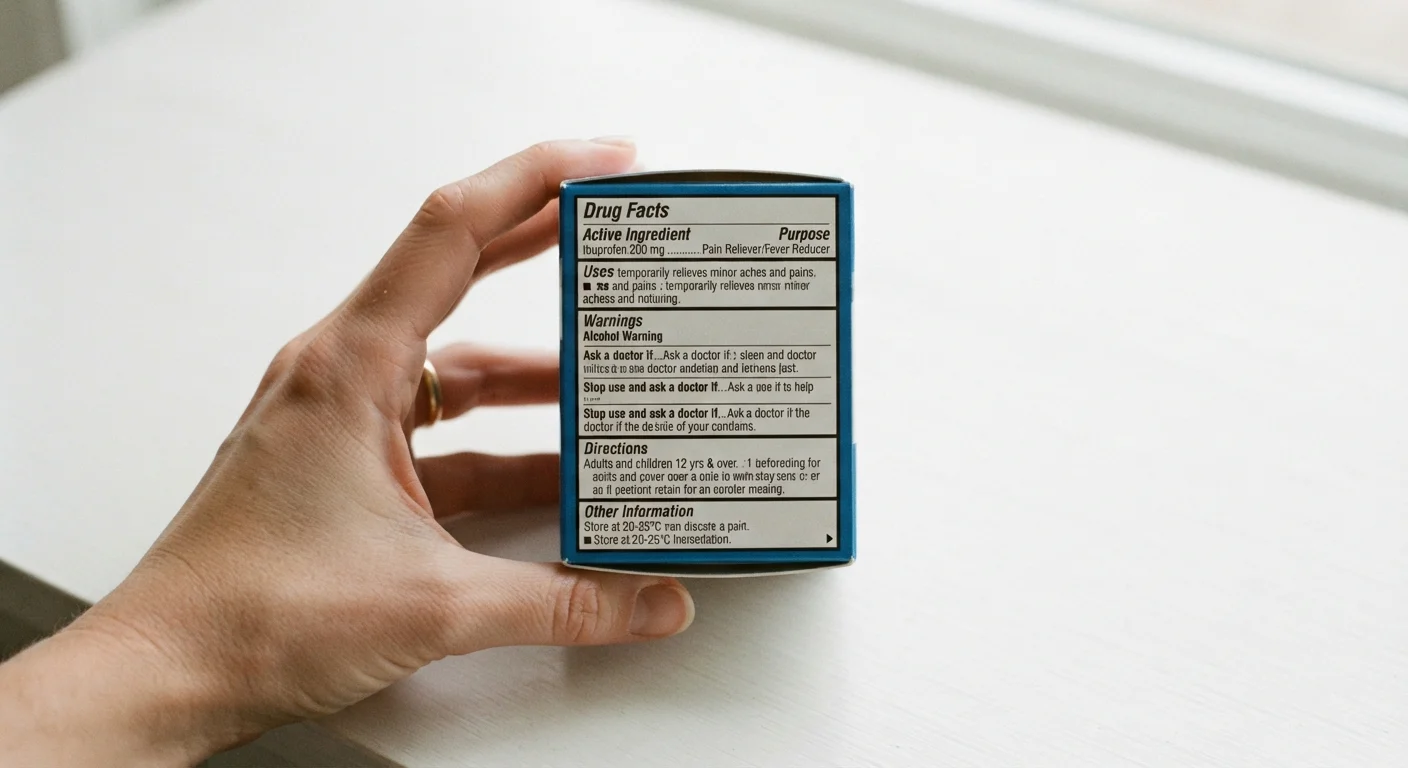
The Drug Facts panel follows a fixed order. Working through it top to bottom — rather than skipping to the directions — gives you the full picture before the box is even opened.
Read the Active Ingredients first
Active ingredients are the substances actually doing the medicinal work. Each one is listed by its official name alongside its amount per dose and its purpose (e.g., "antihistamine," "analgesic," "nasal decongestant"). This section tells you exactly what the product is designed to treat — and helps you spot duplicates if you're using more than one OTC product at a time.
Check the Uses section
The Uses section lists the specific symptoms or conditions the product is approved to treat. This language is FDA-reviewed — if your symptom isn't listed, that product is not the right tool for it, regardless of what the front of the box suggests.
Read every line of the Warnings section
This is the most critical section for safety. Warnings cover:
- Do not use if — absolute contraindications (reasons the product should never be taken)
- Ask a doctor before use if — conditional cautions for people with certain health conditions
- Ask a doctor or pharmacist before use if — drug interaction alerts
- When using this product — side effects to watch for while taking the medicine
- Stop use and ask a doctor if — symptoms that signal a problem requiring professional evaluation
- Pregnancy/breastfeeding caution — most OTC labels advise consulting a doctor before use during pregnancy or while nursing
- Keep out of reach of children — and overdose instructions in case of accidental ingestion
Follow the Directions exactly
Directions specify the dose (how much to take), the frequency (how often), the maximum daily amount, and often the age range for each dose level. Some products include different dose instructions for adults and children. If a product says "do not use more than 3 days" or "do not exceed 4 doses in 24 hours," those limits are clinically grounded — not suggestions.
Note the Other Information and Inactive Ingredients
Other Information typically covers storage conditions (temperature, humidity) and sometimes notes about sodium content relevant for people on restricted diets. Inactive ingredients — binding agents, colorings, flavors, preservatives — don't have therapeutic effects but can trigger reactions in people with specific sensitivities. Scanning this list takes seconds and can prevent an unnecessary allergic response.
Record the manufacturer contact information
The final section of every Drug Facts label includes the name and address of the manufacturer or distributor, along with a phone number or website for questions. If you notice an unusual reaction, a packaging defect, or have questions the label doesn't answer, this is your direct line. You can also report adverse events to the FDA through MedWatch, the FDA's safety reporting program.
Front Labels Can Be Misleading
Marketing language on the front of a box — words like "maximum strength," "non-drowsy," or "multi-symptom" — is designed to attract attention, not inform your decision. The Drug Facts panel on the back or side is the regulated, standardized source. Always flip the box and start there. For a broader look at decoding medication packaging, reading a medication label: every section decoded walks through both OTC and prescription formats.
Common Mistakes and How to Avoid Them
Even careful readers make avoidable errors with OTC labels. Here are the most common pitfalls:
- Using multiple products with the same active ingredient. Acetaminophen appears in hundreds of OTC products — pain relievers, cold medicines, and sleep aids. Taking two simultaneously can push you beyond the daily maximum without realizing it.
- Skipping the age and weight restrictions. Directions often vary by age group. Pediatric doses are not simply smaller adult doses — some products are not appropriate for children under a certain age at all.
- Ignoring the 'Ask a doctor or pharmacist before use' prompts. These are not boilerplate. They flag specific medical conditions or drug combinations that genuinely change the risk profile of the product.
- Overlooking inactive ingredients. Dyes, gluten, lactose, and certain preservatives can matter for people with allergies or intolerances. The inactive ingredients list is the place to check.
For guidance on prescription labels, which follow a different format entirely, see reading your prescription label without the guesswork.
Special Populations Need Extra Caution
OTC does not mean risk-free for everyone. Pregnant or breastfeeding individuals, children under 12, adults over 65, and people with liver or kidney conditions may face heightened risks from ingredients that are generally safe for healthy adults. If a label instructs you to 'ask a doctor before use' and any of these apply, treat that as a required step — not an optional one. A pharmacist can often help you evaluate suitability quickly at no cost.
This article is for general informational purposes only and is not a substitute for professional medical advice. Always consult a qualified healthcare provider or licensed pharmacist for guidance specific to your health situation.