

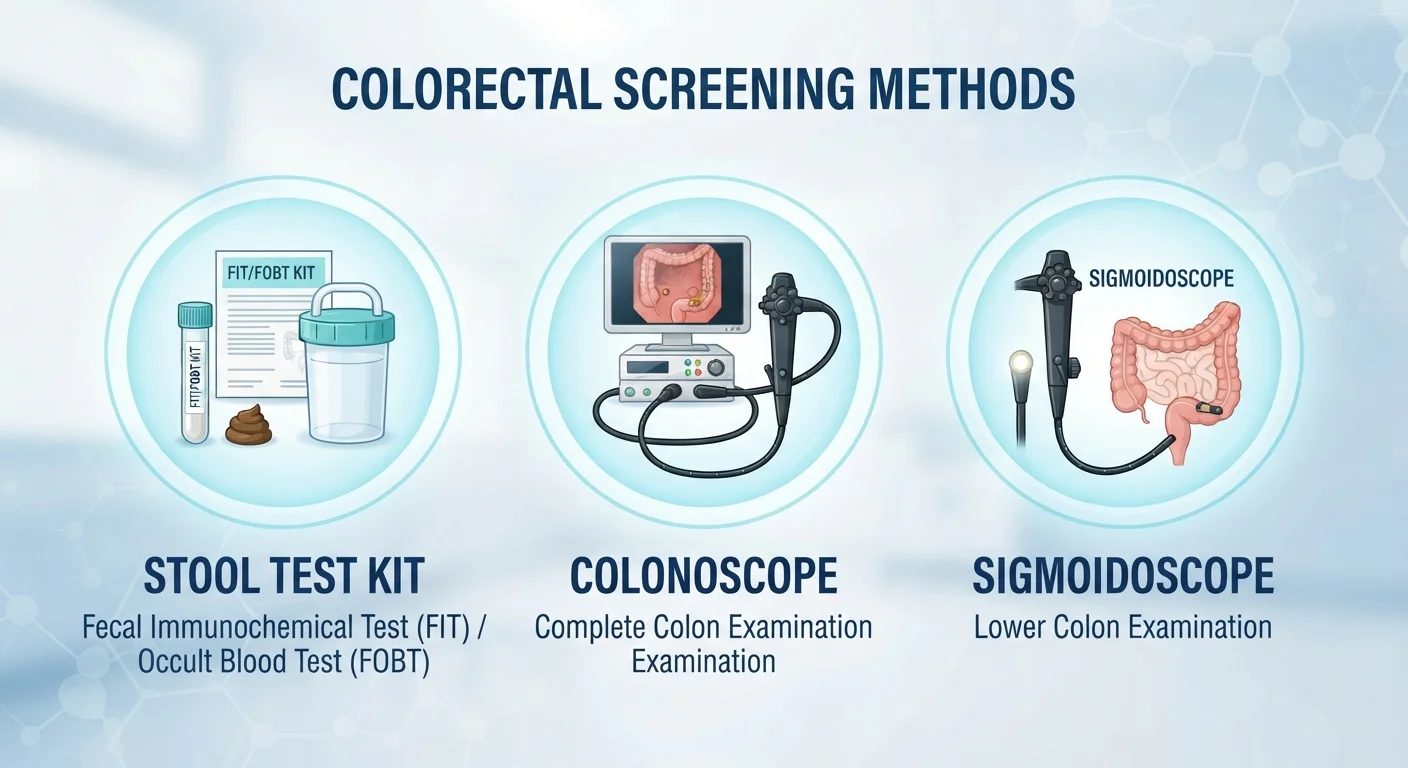
Key Takeaways
- Average-risk adults should begin colorectal cancer screening at age 45, per current US guidelines.
- Stool-based tests are non-invasive and done at home; colonoscopy is both diagnostic and therapeutic.
- Family history or prior polyps can move your screening start date earlier or increase its frequency.
- No single test is universally 'best' — the right choice depends on risk level, preference, and follow-up availability.
- A positive result on any non-colonoscopy test requires a follow-up colonoscopy to be meaningful.
Our Verdict
Stool-based tests offer a low-barrier annual option well-suited to average-risk individuals comfortable with at-home collection. Colonoscopy provides the most comprehensive single evaluation and is the standard follow-up after any abnormal result. Flexible sigmoidoscopy occupies a middle ground — less invasive than colonoscopy but with limited anatomical reach. The right starting point is a conversation with your healthcare provider about personal risk factors and practical access.
| Best for | Recommended |
|---|---|
| Average-risk adults wanting a non-invasive annual option | FIT (Fecal Immunochemical Test) |
| Those seeking a comprehensive, less-frequent procedure | Colonoscopy |
| Adults following up on an abnormal stool test result | Colonoscopy |
| Those at elevated risk due to family history or prior polyps | Colonoscopy (earlier and more frequent) |
Why Bowel Cancer Screening Matters
Colorectal cancer — cancer of the colon or rectum — is among the most preventable cancers when caught early. The US Preventive Services Task Force (USPSTF) recommends that average-risk adults begin screening at age 45 and continue through age 75. Between 76 and 85, the decision is individualized; screening is generally not recommended after 85.
Most colorectal cancers develop slowly from precancerous growths called polyps, which can take years to become malignant. This slow progression is what makes screening so effective — removing polyps before they turn cancerous can interrupt the disease entirely. Yet many families remain uncertain about which test applies to them and when to start.
For a broader look at how screening frequencies are set across different tests, see our guide to standard screening intervals.
| FIT (Annual Stool Test) | Stool DNA Test | Flexible Sigmoidoscopy | Colonoscopy | |
|---|---|---|---|---|
| How it's done | At-home stool sample | At-home stool sample | In-clinic camera procedure | In-clinic camera procedure |
| Area examined | Indirect (blood markers) | Indirect (DNA + blood) | Lower colon only | Entire colon and rectum |
| Recommended frequency | Every year | Every 1–3 years | Every 5 years | Every 10 years |
| Can remove polyps directly | No | No | Limited | Yes |
| Preparation required | Minimal | Minimal | Partial bowel prep | Full bowel prep |
| Follow-up needed if positive | Colonoscopy required | Colonoscopy required | Colonoscopy may follow | Typically none if clear |
| Suitable starting point for average risk | Yes | Yes | Yes (combined with FIT) | Yes |
The Three Main Screening Approaches
Stool-Based Tests
Stool-based tests look for signs of cancer or precancerous change in a fecal sample collected at home. The two most common are:
- FIT (Fecal Immunochemical Test): Detects human blood proteins in stool. Recommended annually. No dietary restrictions required before collection.
- Cologuard (stool DNA test): Combines FIT with testing for abnormal DNA shed by polyps or cancer cells. Recommended every 1–3 years. More sensitive than FIT alone but also generates more false positives.
Crucially, a positive stool test is not a diagnosis — it requires follow-up colonoscopy for confirmation. Skipping that step renders the initial test clinically incomplete.
Colonoscopy
A colonoscopy uses a flexible camera to examine the entire colon and rectum. It is both diagnostic (identifying polyps or tumors) and therapeutic (polyps can be removed during the same procedure). For average-risk adults, it is typically recommended every 10 years if results are normal. The preparation involves a bowel-cleansing process the day before, and sedation is used during the procedure.
Flexible Sigmoidoscopy
This procedure examines only the lower portion of the colon (the sigmoid colon and rectum). It is less invasive than colonoscopy and usually requires less preparation, but it cannot detect abnormalities in the upper colon. When used for screening, it is typically recommended every 5 years, sometimes combined with FIT every year.
Don't Stop at a Positive Stool Test
A positive FIT or stool DNA result is a signal to investigate further — not a diagnosis. Guidelines are clear that a positive result must be followed by colonoscopy to be clinically useful. Delaying or declining the follow-up colonoscopy significantly reduces the value of the original test. Discuss timelines with your provider as soon as you receive results.
Who Needs Earlier or More Frequent Screening
The age-45 start date applies to average-risk individuals. Several factors can shift that timeline earlier or require a more intensive approach:
- Family history: A first-degree relative (parent, sibling, or child) diagnosed with colorectal cancer or advanced polyps before age 60 generally means starting screening at age 40, or 10 years before the relative's diagnosis age — whichever is earlier.
- Personal history of polyps: If a prior colonoscopy found adenomatous polyps, follow-up intervals are shorter, often 3–5 years depending on polyp number, size, and type.
- Inflammatory bowel disease: People with Crohn's disease or ulcerative colitis affecting the colon have elevated risk and typically need surveillance colonoscopies beginning 8 years after diagnosis.
- Genetic syndromes: Conditions such as Lynch syndrome or familial adenomatous polyposis (FAP) carry much higher lifetime risk and require specialist-directed protocols that may begin in the teens or twenties.
Men in particular are statistically diagnosed at younger ages and may benefit from discussing earlier initiation. Our overview of colorectal screening in men covers this in more depth. A broader view of men's screening schedule is also available in men's preventive health screenings by life stage.
Making a Practical Decision with Your Provider
Selecting a screening method isn't purely a clinical question — it also involves logistics, patient preference, and access to follow-up care. Annual stool tests require consistent follow-through every year. Colonoscopy requires arranging time off, a companion for the ride home, and bowel prep. Neither is inherently superior; adherence is what matters most.
When meeting with your provider, useful questions include:
- Based on my personal and family history, which test is appropriate for me?
- If I start with a stool test and it's positive, how quickly can I access follow-up colonoscopy?
- Does my health insurance cover the full cost of follow-up procedures triggered by a positive result?
Families navigating multiple members' health calendars can find it helpful to coordinate screenings alongside other routine checkups. Our family screening preparation guide offers practical steps for doing exactly that. If you're also thinking about other preventive tests, our guide to cervical screening covers another key area of cancer prevention for women.
This article is for general health information only and does not constitute medical advice. Always consult a qualified healthcare provider to determine the screening approach appropriate for your individual health history and risk profile.