

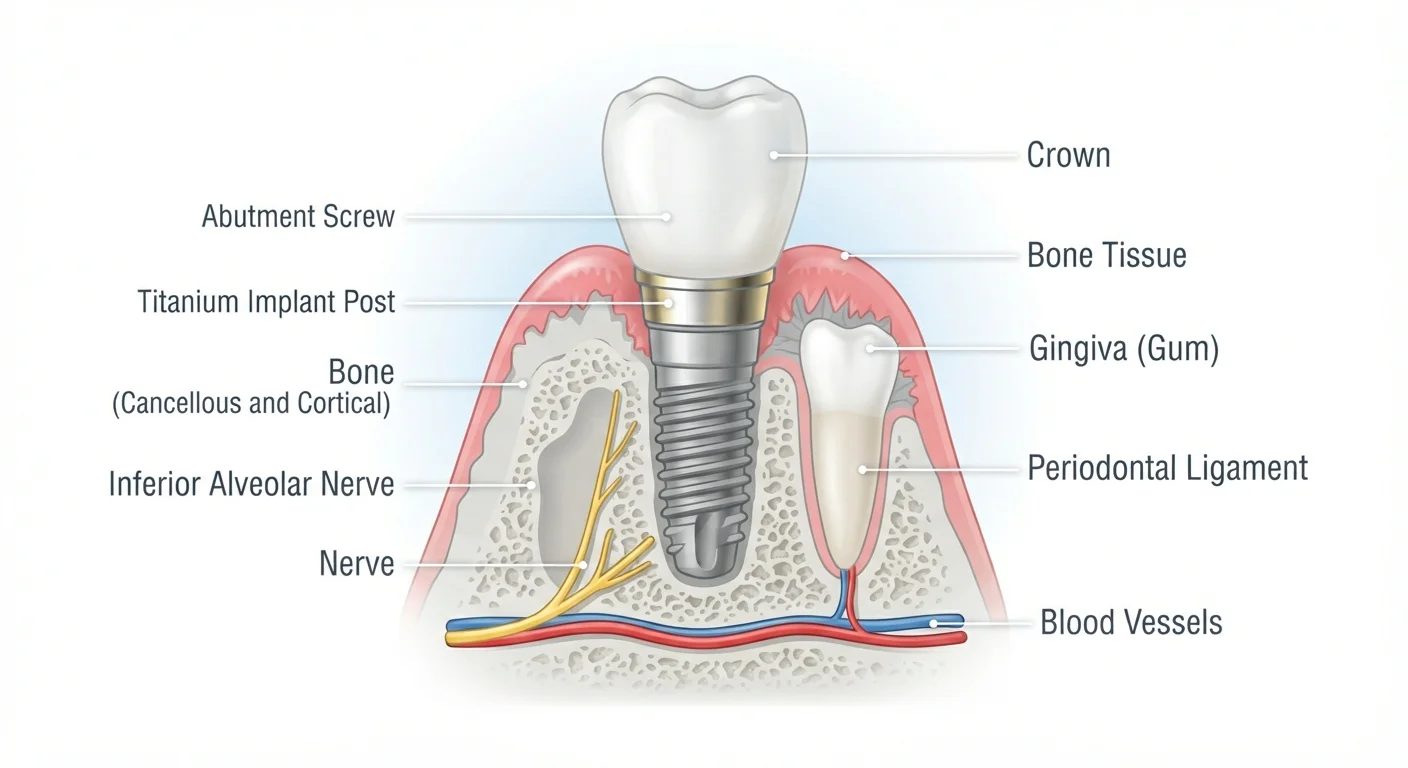
Key Takeaways
- Dental implants are three-part structures: a titanium post, an abutment connector, and a porcelain or ceramic crown.
- The full implant process typically spans several months to allow bone healing between stages.
- Candidates generally need adequate jawbone density, healthy gums, and no uncontrolled systemic conditions.
- Implants do not require altering adjacent healthy teeth, unlike traditional bridges.
- A dentist or oral surgeon evaluates candidacy individually — there is no universal eligibility checklist.
Dental Implant
A dental implant is a small titanium post surgically placed into the jawbone to act as an artificial tooth root. Once the post fuses with the bone, a custom-made crown is attached on top to look and function like a natural tooth. The result is a stable, long-lasting tooth replacement that does not rely on neighboring teeth for support.
The fusion process between the titanium post and living bone is called osseointegration — a biological mechanism that gives implants their structural stability and distinguishes them from surface-level restorations.
The Three-Part Structure of a Dental Implant
Understanding what a dental implant actually consists of helps demystify the treatment. Every implant system has three distinct components, each with a specific role:
- The implant post: A small screw-shaped fixture, typically made from titanium, that is surgically inserted into the jawbone. This functions as the artificial root.
- The abutment: A connector piece that attaches to the top of the post once healing is complete. It serves as the anchor point for the visible restoration.
- The crown: The custom-crafted porcelain or ceramic tooth that attaches to the abutment. This is the only part visible above the gumline.
Together, these three parts replicate the natural tooth from root to tip. Because the post integrates directly with bone, the implant is stable enough to withstand normal biting and chewing forces without support from neighboring teeth — a key advantage over traditional bridges, which require reshaping adjacent healthy teeth to hold a replacement in place. For a side-by-side look at how these options differ, see our guide to tooth replacement options.
Unfamiliar With Dental Terms?
Implant consultations often introduce clinical language that can feel overwhelming. Terms like 'osseointegration,' 'abutment,' and 'periapical' have precise meanings that affect how your treatment is explained. Our dental terminology reference provides plain-language definitions for the terms families most commonly encounter.
The Implant Process: Stage by Stage
Dental implant treatment is not a single appointment — it unfolds across several carefully sequenced stages, often over a period of months.
- Initial evaluation: The dentist or oral surgeon assesses jawbone density (often via X-ray or cone-beam CT scan), gum health, and overall medical history to determine suitability.
- Preparatory procedures (if needed): Some patients require bone grafting to build up insufficient bone volume, or treatment for existing gum disease, before implant placement can proceed.
- Surgical placement: The titanium post is placed into the jawbone under local anesthesia. The site is then closed and allowed to heal.
- Osseointegration: Over two to six months, the bone gradually fuses with the titanium surface — a process called osseointegration. This biological bond is what gives the implant its strength.
- Abutment placement: Once integration is confirmed, a minor procedure attaches the abutment to the top of the post.
- Crown fitting: Impressions or digital scans are taken to fabricate a custom crown, which is then secured to the abutment.
Each stage has a clinical purpose. Skipping or rushing steps — particularly osseointegration — risks implant failure, which is why the timeline cannot always be shortened.
95%+
Long-term implant survival rate
Research consistently shows implant survival rates above 95% over ten years when placed in suitable candidates, according to systematic reviews in peer-reviewed dental literature.
3–6 months
Typical osseointegration period
Most dental guidelines cite a healing window of two to six months for the titanium post to fuse with jawbone before the final crown can be placed.
~3 million
Americans with dental implants
The American Academy of Implant Dentistry has estimated that approximately 3 million Americans have dental implants, with that number growing each year.
Who Is Generally Considered a Suitable Candidate?
Candidacy for dental implants is determined on a case-by-case basis. No two patients are identical, and a thorough clinical evaluation is always required. That said, several general factors tend to support or complicate candidacy:
Factors that typically support candidacy
- Sufficient jawbone density and volume to anchor the post
- Healthy gum tissue free from active periodontal disease
- Good overall health, with any chronic conditions well-managed
- Non-smoking status, or willingness to stop — smoking significantly impairs healing and implant integration
- Fully developed jaw (implants are generally not placed until jaw growth is complete, usually in the late teens or early adulthood)
Factors that may complicate or delay candidacy
- Insufficient bone density (may be addressable with grafting)
- Uncontrolled diabetes or other systemic conditions affecting healing
- Active gum disease requiring treatment first
- Certain medications that affect bone metabolism — always disclose your full medication list to your provider
- Heavy smoking or tobacco use
If a dentist determines that a patient is not yet a candidate, that does not always mean implants are permanently off the table. Bone grafting, periodontal treatment, and improved systemic health management may open the door over time. For patients weighing whether an extraction might precede an implant, our family guide to tooth extractions explains that process in plain terms.
This article is for general informational purposes only and does not constitute medical or dental advice. If you are considering dental implants, consult a licensed dental professional who can evaluate your individual circumstances.