

Key Takeaways
- Dental bridges, dentures, and implants each address missing teeth differently, with distinct trade-offs in cost, durability, and maintenance.
- Implants are the only option that replaces the tooth root, which helps preserve jawbone density over time.
- Bridges require reshaping adjacent healthy teeth, while dentures are removable and involve no surgical component.
- Candidacy for each option depends on jawbone health, number of missing teeth, overall oral health, and personal preference.
- Always consult a licensed dentist to determine which approach suits your specific clinical situation.
Our Verdict
No single tooth replacement option is universally superior — the right choice depends on individual clinical factors, lifestyle preferences, and cost considerations. Implants offer the closest functional substitute to a natural tooth but require surgery and adequate bone support. Bridges offer a fixed solution without surgery but involve modifying adjacent teeth. Dentures provide the most accessible entry point when multiple teeth are missing or budgets are constrained.
| Best for | Recommended |
|---|---|
| Those replacing one or two missing teeth with healthy neighboring teeth | Dental bridge |
| Those seeking the most durable, bone-preserving long-term solution | Dental implant |
| Those missing many or all teeth, or for whom surgery is not suitable | Dentures |
| Those wanting a removable implant-supported option with improved stability | Implant-supported dentures |
Why Tooth Replacement Matters Beyond Appearance
Missing teeth affect more than how you look. Gaps in your smile change how you bite, can cause neighboring teeth to shift over time, and lead to gradual bone loss in the jaw where the root once sat. These downstream effects make tooth replacement a genuine health consideration, not just a cosmetic one.
Three treatment paths are most commonly discussed: dental bridges, removable dentures, and dental implants. Each has a distinct mechanism, a different level of invasiveness, and its own set of maintenance demands. Understanding these differences helps you walk into a dental consultation better prepared — not to self-prescribe, but to ask the right questions. For a plain-language guide to the terminology you may encounter along the way, see our dental treatment glossary.
How Each Option Works
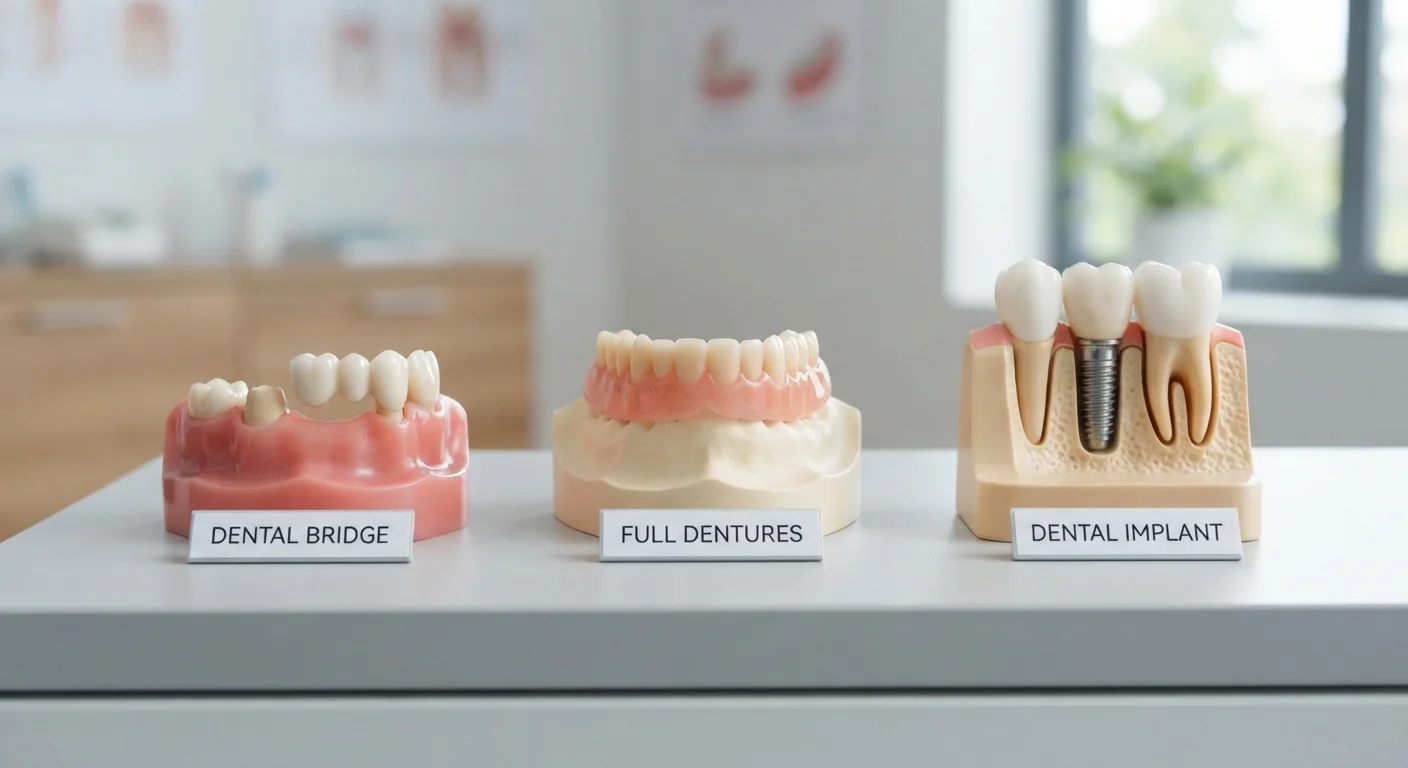
Dental bridges span the gap left by one or more missing teeth. A false tooth — called a pontic — is anchored to the natural teeth on either side of the gap (the abutment teeth). Those neighboring teeth must be filed down to accommodate the crowns that hold the bridge in place. The result is a fixed, non-removable restoration that looks and functions much like natural teeth. For more on how crowns factor into restorative decisions, see our comparison of crowns and fillings.
Dentures are removable appliances that rest on the gum tissue. Full dentures replace an entire arch of teeth; partial dentures replace several missing teeth while clasping onto remaining natural ones. They require no surgery and can often be fitted relatively quickly, though adjustment periods of several weeks are common as gums change shape.
Dental implants involve placing a titanium post directly into the jawbone to act as an artificial root. Once the bone fuses around the post — a process called osseointegration that typically takes several months — a crown is attached on top. For a detailed breakdown of how this process unfolds and who is typically a candidate, see our implant explainer.
| Dental Bridge | Dentures | Dental Implant | |
|---|---|---|---|
| How it stays in place | Fixed to adjacent teeth | Rests on gum tissue (removable) | Anchored in jawbone (fixed) |
| Surgery required | No | No | Yes |
| Effect on jawbone | Moderate bone loss over time | Accelerates bone loss | Stimulates bone, minimizes loss |
| Impact on neighboring teeth | Requires reshaping | Minimal (partial) or none (full) | None |
| Typical lifespan | 10–15 years with care | 5–10 years before relining | 15+ years, potentially lifelong |
| Maintenance | Floss threaders required | Daily removal and cleaning | Brush and floss normally |
| General cost range | Moderate | Lower upfront cost | Higher upfront cost |
Key Trade-Offs to Consider
Each option involves meaningful compromises. Bridges permanently alter otherwise healthy neighboring teeth — a consideration worth weighing carefully if those teeth are structurally sound. Dentures, while accessible, can shift or require adhesives, and bone loss beneath them may accelerate over years without a root to stimulate the jaw. For a balanced look at the limitations involved, see our detailed denture overview.
Implants sidestep many of these drawbacks but demand adequate bone volume, healthy gums, and no contraindications to surgery. They also involve a longer treatment timeline — sometimes six months to over a year — and higher upfront costs. Implant-supported dentures represent a middle path: implant posts improve denture stability without requiring an individual implant for every missing tooth.
Ask About Implant-Supported Dentures
If you need to replace multiple teeth but find conventional dentures unstable, ask your dentist whether implant-supported dentures might be appropriate. A small number of implant posts can dramatically improve denture retention and comfort without the cost of individual implants for each missing tooth. Candidacy still depends on bone health and overall suitability for surgery.
Ongoing maintenance also differs substantially. Bridges require diligent cleaning beneath the pontic using floss threaders or interdental tools. Dentures must be removed and cleaned daily. Implant crowns are brushed and flossed like natural teeth. For guidance on between-teeth cleaning tools, see our comparison of interdental cleaning methods.
Questions Worth Asking Your Dentist
No single option fits every patient. Your dentist or a specialist such as a prosthodontist or oral surgeon will evaluate the number and position of missing teeth, the health of surrounding teeth and gums, jawbone density, and your overall medical history before making a recommendation.
- Am I a surgical candidate for implants, and is my bone density sufficient?
- Which neighboring teeth would need to be modified for a bridge?
- How will bone loss progress if I choose dentures over time?
- What is the realistic lifespan of each option in my specific situation?
- How does each option affect adjacent teeth and long-term oral health?
This article is for general informational purposes only and does not constitute dental or medical advice. Always consult a qualified dental professional for evaluation and treatment recommendations tailored to your individual needs.