

Key Takeaways
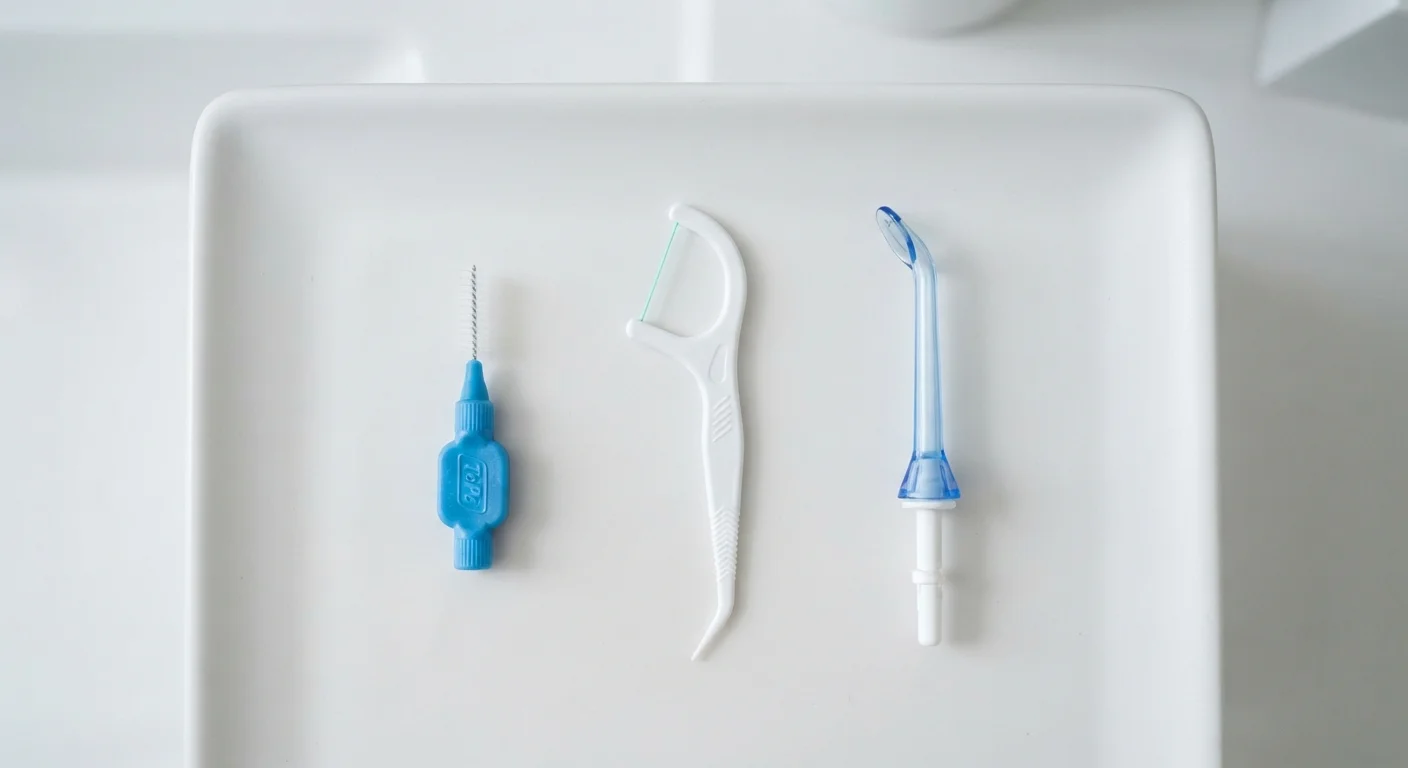
- Interdental brushes are particularly effective for wider gaps and around dental work such as bridges or implants.
- Floss picks offer a portable, familiar option for tight contacts between teeth, closely mimicking traditional floss.
- Water flossers use pressurized water to dislodge debris and are well-suited for people with braces or sensitive gums.
- No single tool is universally superior — your dental anatomy and lifestyle should guide your choice.
- Any consistent interdental cleaning is significantly better than skipping it entirely.
Our Verdict
All three tools can meaningfully reduce plaque and gum disease risk when used correctly and consistently. The right choice depends on the size of your interdental spaces, any dental appliances you wear, your manual dexterity, and what you're most likely to use every day. Ask your dentist or hygienist which option suits your specific oral anatomy.
| Best for | Recommended |
|---|---|
| Wider interdental gaps or those with bridges and implants | Interdental brushes |
| Tight tooth contacts and those who prefer a familiar flossing feel | Floss picks |
| Orthodontic appliances, limited dexterity, or sensitive gum tissue | Water flossers |
| On-the-go cleaning or travel | Floss picks |
Why Interdental Cleaning Matters
A toothbrush — whether manual or electric — cleans the exposed surfaces of teeth effectively, but it cannot reach the narrow spaces between teeth. These interproximal spaces are prime sites for plaque accumulation, which, left undisturbed, can lead to cavities and gum disease (periodontitis). The American Dental Association recommends cleaning between teeth at least once a day.
Yet compliance is notoriously low. One barrier is tool confusion — many adults aren't sure which interdental device to choose, or whether their current choice is actually doing the job. If you're reviewing your full daily routine, our guide to auditing your oral health habits is a useful starting point. This article focuses specifically on three widely available tools: interdental brushes, floss picks, and water flossers.
Interdental Brushes: Best for Wider Gaps
Interdental brushes — sometimes called interproximal brushes or proxy brushes — are small, bristled wands designed to slide between teeth. They come in a range of sizes (typically color-coded) to match different gap widths. The brush physically scrubs the sides of adjacent teeth and the gumline, removing plaque through mechanical action.
Key strengths:
- Highly effective at removing plaque in gaps of moderate to large size, with some clinical research suggesting they outperform floss in these spaces
- Well-suited for use around dental bridges, implants, and fixed retainers, where traditional floss is difficult to thread
- Reusable for several days with proper rinsing, reducing waste
Limitations: They are not appropriate for very tight contacts — forcing an oversized brush between teeth can damage gum tissue. Correct sizing is important; your dentist or hygienist can help identify the right fit. If you're exploring restoration options that may affect your interdental spaces, see our overview of bridges, dentures, and implants.
| Interdental Brush | Floss Pick | Water Flosser | |
|---|---|---|---|
| Mechanism | Mechanical bristle scrubbing | Mechanical floss scraping | Pressurized water flushing |
| Best gap size | Moderate to wide gaps | Tight contacts | Any gap size |
| Plaque removal efficacy | High (wider spaces) | High (tight spaces) | Moderate alone; better as complement |
| Ease of use | Moderate — sizing required | Easy — familiar technique | Easy — minimal technique needed |
| Portability | Good — compact | Excellent — pocket-sized | Limited — requires device and water |
| Suited for dental appliances | Excellent (bridges, implants) | Limited | Excellent (braces, aligners) |
| Cost (ongoing) | Low — reusable several days | Low — single-use | Higher — device investment |
Floss Picks: A Familiar, Portable Option
Floss picks (also called dental picks or flossers) consist of a short length of floss stretched between two prongs on a plastic handle. They work in essentially the same way as traditional string floss — the floss slides between teeth and curves around each tooth in a "C" shape to scrape plaque from the tooth surface and just below the gumline.
Key strengths:
- Easier to maneuver for people who find traditional floss awkward, including those with limited hand dexterity
- Compact and convenient for use away from home
- Effective for tight contacts where interdental brushes won't fit
Limitations: A single floss pick uses the same small segment of floss for every gap, which can redistribute bacteria rather than remove it. Technique still matters — the floss must curve around each tooth rather than snap straight up and down.
Choosing the Right Tool for Your Anatomy
The most effective interdental tool is the one that fits your teeth and that you'll actually use every day. If you're unsure which option suits your gap sizes or dental work, ask your hygienist at your next cleaning — they can assess your interdental spaces and demonstrate proper technique in under two minutes. Combining tools (for example, an interdental brush for back teeth and a floss pick for tighter front contacts) is also a valid approach.
Water Flossers: Pressure-Based Plaque Disruption
Water flossers (oral irrigators) use a pressurized stream of water to flush debris and disrupt plaque from between teeth and below the gumline. They do not physically scrub tooth surfaces the way bristles or floss do, but they are effective at flushing out loosened particles and reducing gum inflammation.
Key strengths:
- Particularly valuable for people wearing braces or clear aligners, where threading floss is time-consuming
- Useful for those with gum pockets (shallow spaces between the gum and tooth that form in early gum disease), as the stream can reach slightly below the gumline
- Gentler on sensitive or inflamed gum tissue compared to string floss
Limitations: Research generally shows water flossers are less effective than floss or interdental brushes at physically removing adherent plaque when used alone. They are best viewed as a complement to, rather than a replacement for, mechanical cleaning. They also require a power source and a reservoir of water, making them less portable.
Whichever tool you choose, consistency matters more than perfection. For a broader look at how your choice of brushing tool fits into your overall routine, see our comparison of electric vs. manual toothbrushes.
This article is for general informational purposes only and is not a substitute for professional dental advice. Consult your dentist or dental hygienist to determine the most appropriate interdental cleaning method for your specific oral health needs.