

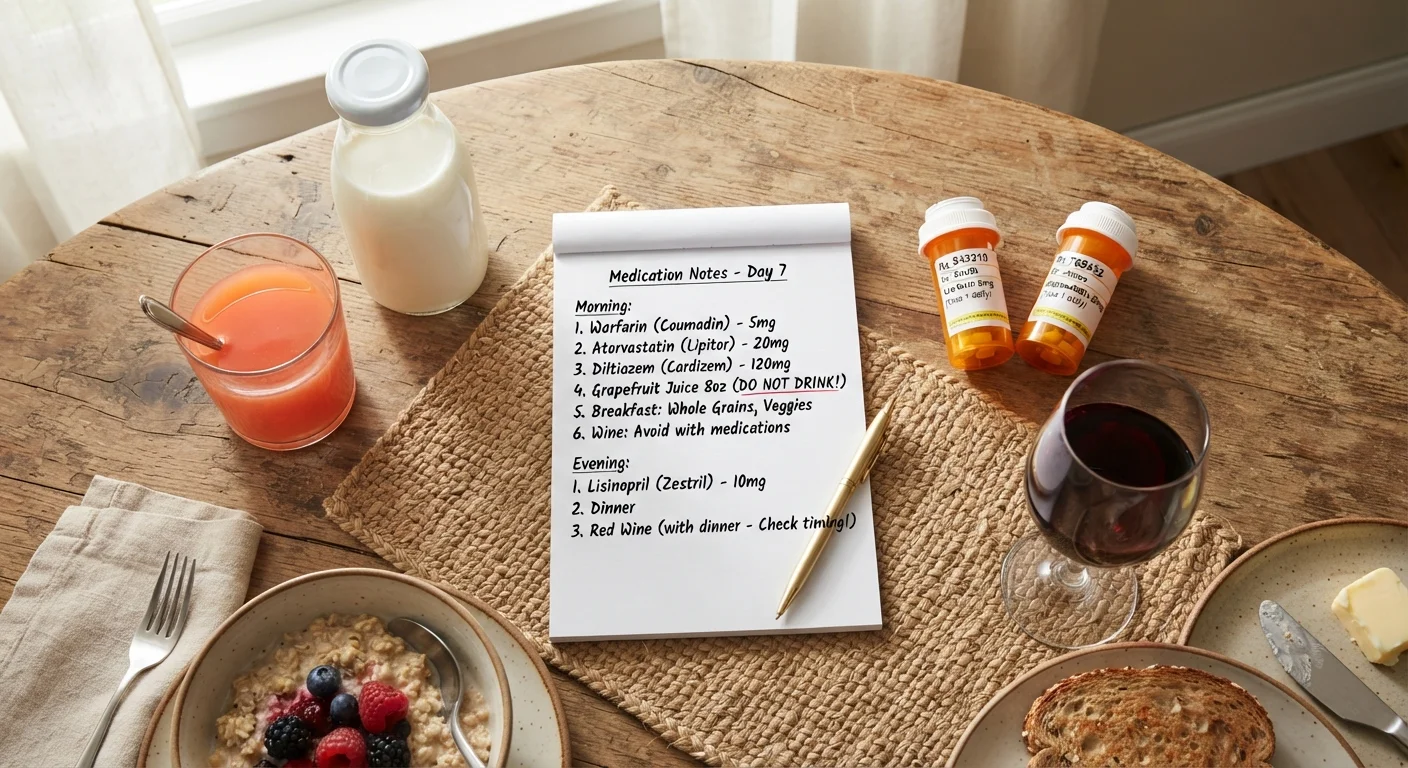
Key Takeaways
- Grapefruit and grapefruit juice can dangerously elevate blood levels of certain medications.
- Dairy products and calcium-rich foods can block absorption of some antibiotics and thyroid medications.
- Alcohol interacts with dozens of common drugs, amplifying sedation or increasing bleeding risk.
- High-vitamin K foods like leafy greens can reduce the effectiveness of blood thinners like warfarin.
- Caffeine and tyramine-rich foods can interact with specific psychiatric and cardiovascular medications.
- Always ask your pharmacist or prescriber whether any foods need to be avoided with a new medication.
Why What You Eat and Drink Matters for Medication
Most people know to check whether a new prescription interacts with other drugs. Far fewer think to check whether it interacts with what's on their dinner plate. Yet food-drug interactions are a well-documented concern in pharmacy practice — and some can be clinically significant, affecting how much of a medication reaches your bloodstream or how quickly your body processes it.
These interactions generally work in one of two ways: a substance either speeds up or slows down the enzymes and proteins your body uses to metabolize (break down) a drug. The result can be a medication that works less effectively, or one whose effects are amplified to potentially harmful levels. Understanding the most common culprits gives families a practical advantage in medication safety.
The list below covers the food and drink interactions that pharmacists most commonly flag. It is not exhaustive — your specific medications may carry additional restrictions. Always review prescription labels carefully and consult a pharmacist or prescriber when starting anything new. For a broader look at how drug interactions occur and why they matter, see our guide to drug interactions families should understand.
Grapefruit and Grapefruit Juice
Grapefruit contains compounds called furanocoumarins that inhibit an enzyme in the gut and liver known as CYP3A4. This enzyme is responsible for breaking down a wide range of medications. When it is blocked, drug levels in the bloodstream can rise significantly — in some cases to dangerous concentrations.
Medications commonly affected include certain statins (used for cholesterol), calcium channel blockers (used for blood pressure), some immunosuppressants, and certain anti-anxiety drugs. The effect can persist for 24 hours or more after consuming grapefruit, so simply separating intake by a few hours is not always sufficient. Seville oranges, pomelos, and tangelos carry similar risks.
Grapefruit's effect on drug metabolism can last over 24 hours — timing alone may not protect you.
Dairy Products and Calcium-Rich Foods
Calcium ions in dairy products (and calcium-fortified foods) can bind to certain medications in the digestive tract, forming insoluble compounds that the body cannot absorb effectively. This process, called chelation, is most clinically relevant for fluoroquinolone and tetracycline antibiotics, where dairy consumption around the time of dosing can substantially reduce how much of the drug enters circulation.
Levothyroxine, a thyroid hormone replacement taken by many adults, is similarly affected by calcium — including supplements. Patients on this medication are typically instructed to take it on an empty stomach, separated from any calcium-containing food or supplement by at least four hours.
Calcium can bind to certain antibiotics and thyroid medications, reducing how much the body absorbs.
Alcohol
Alcohol interacts with a particularly broad spectrum of medications. Its central nervous system depressant properties can combine additively — or synergistically — with sedatives, sleep aids, antihistamines, opioids, and some antidepressants, deepening sedation and impairing coordination and judgment far beyond what either substance would cause alone.
Beyond sedation, alcohol can increase bleeding risk when combined with blood thinners such as warfarin, and it places additional metabolic strain on the liver when taken alongside acetaminophen (paracetamol), even at recommended doses. Some antibiotics — notably metronidazole and tinidazole — produce a severe reaction (flushing, nausea, rapid heartbeat) when alcohol is consumed. Patients should always check whether alcohol avoidance is necessary for their specific prescription.
Alcohol interacts with dozens of medications, from sleep aids to antibiotics, often with serious consequences.
Vitamin K–Rich Foods and Blood Thinners
Warfarin (a commonly prescribed anticoagulant, or blood thinner) works by interfering with vitamin K–dependent clotting factors. Foods high in vitamin K — particularly leafy greens like kale, spinach, collard greens, and broccoli — can counteract this effect when consumed in large or inconsistent amounts, making the medication less effective and increasing clotting risk.
The key concern here is not necessarily the foods themselves, but inconsistency. Patients on warfarin are generally advised to maintain a steady, moderate intake of vitamin K foods rather than eliminating them entirely. Sudden large increases or decreases in vitamin K consumption can destabilize INR readings (a blood test used to monitor warfarin's effect). Newer anticoagulants may have different dietary considerations — ask your prescriber or pharmacist about your specific drug.
Inconsistent vitamin K intake — not leafy greens themselves — is the primary concern for warfarin users.
Caffeine
Caffeine is metabolized by the CYP1A2 enzyme system. Certain medications — including the asthma drug theophylline and the antibiotic ciprofloxacin — can inhibit this enzyme, causing caffeine to accumulate to higher-than-expected levels. The result can be exaggerated caffeine effects: jitteriness, rapid heart rate, insomnia, or anxiety.
The interaction can run in reverse as well: some medications may reduce caffeine's effect, or caffeine may influence the metabolism of the drug itself. For most people consuming moderate caffeine, this is not a severe risk — but it is worth noting for anyone sensitive to caffeine's effects or taking medications known to affect CYP1A2.
Some medications can cause caffeine to accumulate in the body, amplifying its stimulant effects.
Tyramine-Rich Foods and MAOIs
Monoamine oxidase inhibitors (MAOIs) are a class of antidepressants that, while less frequently prescribed today, are still in use. They block the enzyme that breaks down tyramine, an amino acid found in aged and fermented foods. When tyramine builds up in the body, it can trigger a rapid, dangerous increase in blood pressure known as a hypertensive crisis.
Foods high in tyramine include aged cheeses, cured and fermented meats, sauerkraut, soy sauce, tap beer, and some wines. Patients prescribed an MAOI should receive a comprehensive dietary counseling list from their prescriber or pharmacist and follow it strictly. This interaction illustrates why it is critical to disclose all medications — including psychiatric drugs — to every member of your care team.
Tyramine-rich foods can trigger dangerous blood pressure spikes in patients taking MAOI antidepressants.
High-Fat Meals and Drug Absorption
Fat content in a meal can meaningfully influence how some medications are absorbed. For certain drugs — including some HIV antiretrovirals and the antifungal itraconazole — a high-fat meal actually improves absorption and is recommended. For others, taking a medication with a fatty meal can delay onset or alter peak concentration in unintended ways.
Some extended-release formulations may also behave differently with high-fat foods. This is why medication labels sometimes specify "take with food," "take on an empty stomach," or "take with a full meal" — instructions that are rarely arbitrary. Following these directions as written helps ensure predictable drug performance and is one of the simplest things families can do to use medications safely. For more on how everyday habits intersect with medication safety, see OTC interactions with prescription drugs that families often miss.
Whether a meal is high in fat can directly alter how much of some medications your body absorbs.
Staying Ahead of Food-Drug Interactions
The good news is that most food-drug interactions are predictable and avoidable once you know what to look for. The label on your prescription bottle is the first place to check — many pharmacies print explicit food warnings directly on the packaging. Your dispensing pharmacist is your most accessible resource: they can quickly cross-reference your full medication list against common dietary interactions at no cost.
Ask Your Pharmacist About Food Restrictions
When picking up any new prescription, ask your pharmacist specifically: "Are there any foods, drinks, or supplements I should avoid while taking this?" This single question takes under a minute and can prevent a clinically significant interaction. Pharmacists are trained to answer exactly these questions and can flag interactions that may not appear on the printed label.
It is also worth knowing that some interactions are time-sensitive rather than absolute. With certain antibiotics, for example, the concern is not that dairy makes the drug harmful — it just reduces absorption. Taking the medication two hours before or after dairy is often all that is needed. Your pharmacist can clarify whether separation is sufficient or whether a food must be avoided altogether.
Families managing medications across multiple age groups — children, adults, and older adults — face a compounded risk, since older adults in particular are often on multiple prescriptions simultaneously. If you want to explore how everyday medication habits contribute to broader safety concerns, medication mistakes families make without realising is a useful companion read. A full framework for managing medications safely across all ages is available in our complete family medication safety guide.
This article is for general informational purposes only and does not constitute medical or pharmaceutical advice. Always consult a licensed pharmacist, physician, or other qualified healthcare professional regarding your specific medications and dietary needs.