

| Number of distinct hormonal methods | 6+ (pill, patch, ring, injection, implant, hormonal IUD) |
| Combined pill — typical-use efficacy | ~91% (CDC, Contraceptive Technology) |
| Hormonal IUD — typical-use efficacy | >99% (CDC, Contraceptive Technology) |
| Contraceptive implant duration | Up to 3 years (FDA-approved labeling) |
| Injection (DMPA) frequency | Every 3 months |
| Return to fertility after stopping | Varies by method; most return promptly (ACOG guidance) |
How Hormonal Contraceptives Work
Hormonal contraceptives use synthetic versions of estrogen, progestin, or both to alter the reproductive environment and reduce the likelihood of pregnancy. To understand why these interventions are effective, it helps to first understand the underlying cycle they modify — see our guide to the female hormonal cycle for a phase-by-phase explanation.
Most methods work through one or more of three primary mechanisms:
- Ovulation suppression: Synthetic hormones signal the pituitary gland to reduce the hormones (LH and FSH) that trigger egg release.
- Cervical mucus thickening: Progestin makes the mucus at the cervix denser, impeding sperm movement.
- Endometrial changes: The uterine lining becomes less receptive to implantation, though this is considered a secondary mechanism.
No single mechanism applies equally to all methods, and the dominant mechanism varies by formulation and delivery system.
Progestin
A synthetic form of the hormone progesterone used in many hormonal contraceptives. Different progestins have slightly different properties and side-effect profiles.
Combined oral contraceptive (COC)
A daily pill containing both synthetic estrogen and progestin. Often called 'the pill,' it is one of the most widely used forms of hormonal contraception.
Intrauterine device (IUD)
A small, T-shaped device inserted into the uterus by a clinician. Hormonal IUDs release low-dose progestin locally; non-hormonal copper IUDs work differently.
Efficacy (typical vs. perfect use)
Perfect-use efficacy reflects effectiveness when a method is used exactly as directed every time. Typical-use efficacy accounts for real-world human error and is generally lower.
Ovulation suppression
One of the primary mechanisms of many hormonal contraceptives — preventing the ovary from releasing an egg, which reduces the chance of fertilization.
Cervical mucus thickening
A secondary contraceptive mechanism in which progestin makes cervical mucus denser, making it harder for sperm to reach the egg.
Overview of Common Hormonal Methods
The following categories represent the most widely used hormonal contraceptive approaches. Each differs in hormone type, delivery route, duration, and typical-use effectiveness.
| Number of distinct hormonal methods | 6+ (pill, patch, ring, injection, implant, hormonal IUD) |
| Combined pill — typical-use efficacy | ~91% (CDC, Contraceptive Technology) |
| Hormonal IUD — typical-use efficacy | >99% (CDC, Contraceptive Technology) |
| Contraceptive implant duration | Up to 3 years (FDA-approved labeling) |
| Injection (DMPA) frequency | Every 3 months |
| Return to fertility after stopping | Varies by method; most return promptly (ACOG guidance) |
Short-Acting Methods
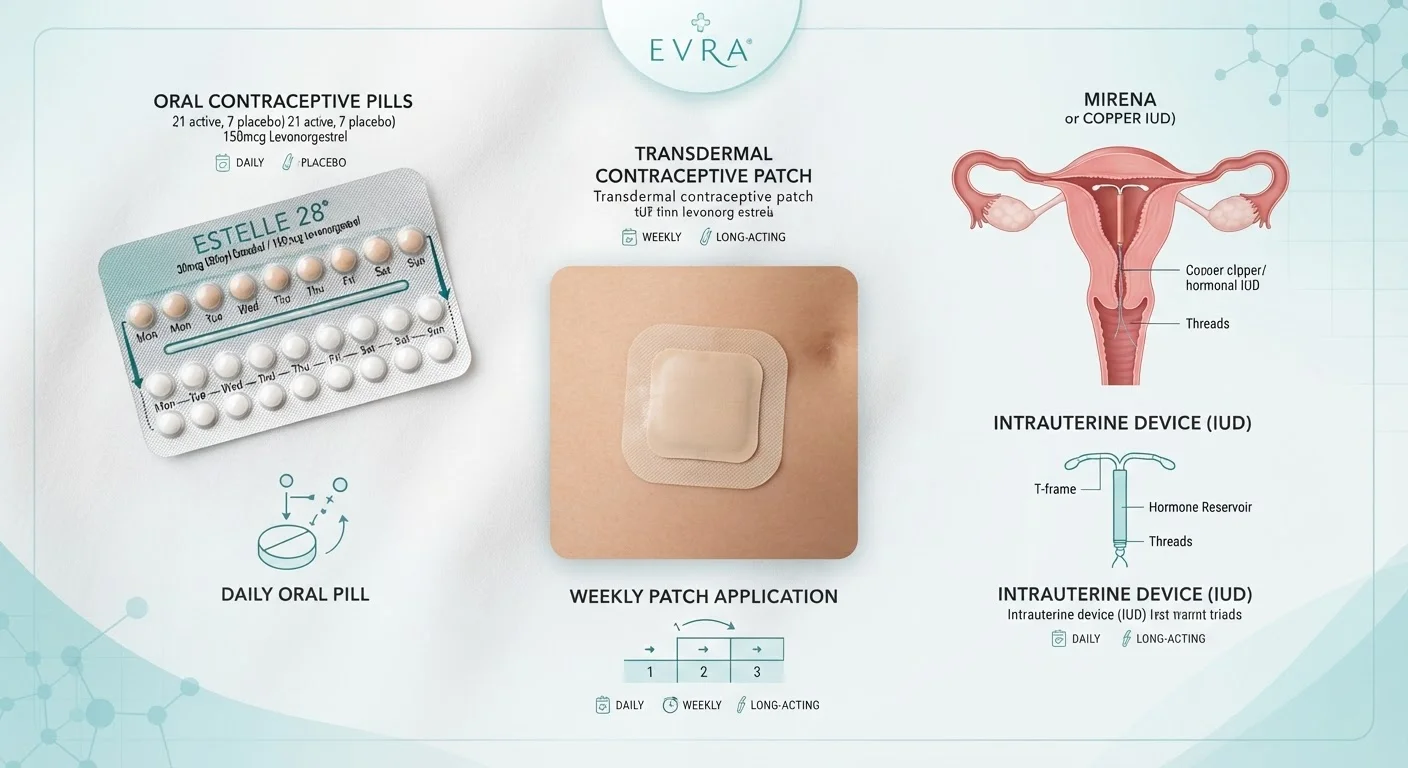
Combined oral contraceptives (COCs) contain both synthetic estrogen and progestin, taken daily. They primarily suppress ovulation. Progestin-only pills (sometimes called the 'mini-pill') rely mainly on cervical mucus thickening and must be taken at a consistent time each day. The contraceptive patch delivers combined hormones transdermally (through the skin) and is changed weekly. The vaginal ring releases hormones locally over a three-to-four-week cycle.
Long-Acting Reversible Contraceptives (LARCs)
Hormonal IUDs release low-dose progestin directly into the uterus for three to eight years depending on the specific device, with typical-use and perfect-use efficacy both exceeding 99%. The subdermal implant — a small rod inserted under the skin of the upper arm — releases progestin for up to three years and is similarly highly effective. LARCs are discussed in detail by hormonal health resources from clinical authorities.
Injectable Contraception
The depot medroxyprogesterone acetate (DMPA) injection is administered by a healthcare provider every three months. It suppresses ovulation effectively but is associated with a variable delay in return to fertility after discontinuation — a consideration for those planning future pregnancies.
Key Differences and Considerations
Choosing among methods involves weighing several factors that vary by individual health profile, lifestyle, and reproductive goals. The following are areas where methods differ meaningfully:
- Hormone type: Combined methods include estrogen-containing options, which are contraindicated for some people (e.g., those with a history of migraines with aura, certain cardiovascular risk factors, or who smoke and are over 35). Progestin-only options may be appropriate in these cases.
- Duration and reversibility: Short-acting methods (pills, patch, ring) allow rapid return to fertility on discontinuation. LARCs also allow fertility to return after removal, though it may take slightly longer after the injection.
- Adherence requirements: Daily pill-taking demands consistent routine. LARCs require no ongoing user action after placement.
- Non-contraceptive effects: Some methods are clinically used to manage conditions such as endometriosis, heavy menstrual bleeding, or dysmenorrhea (painful periods). These uses require individualized clinical assessment.
Understanding how hormones shift throughout life is also relevant context — our overview of hormonal health across a woman's lifetime covers how estrogen and progesterone levels change from adolescence onward.
This Article Is for General Information Only
The content here describes hormonal contraceptive methods at a general, factual level. It is not a substitute for personalized medical advice. Suitability depends on individual health history, risk factors, and goals — all of which should be discussed with a qualified healthcare provider.
Hormonal contraceptives do not protect against sexually transmitted infections (STIs). For STI prevention, barrier methods such as condoms must be used separately.
This article provides general health information and is not a substitute for personalized medical advice. Always consult a qualified healthcare provider before starting, stopping, or changing any contraceptive method.