

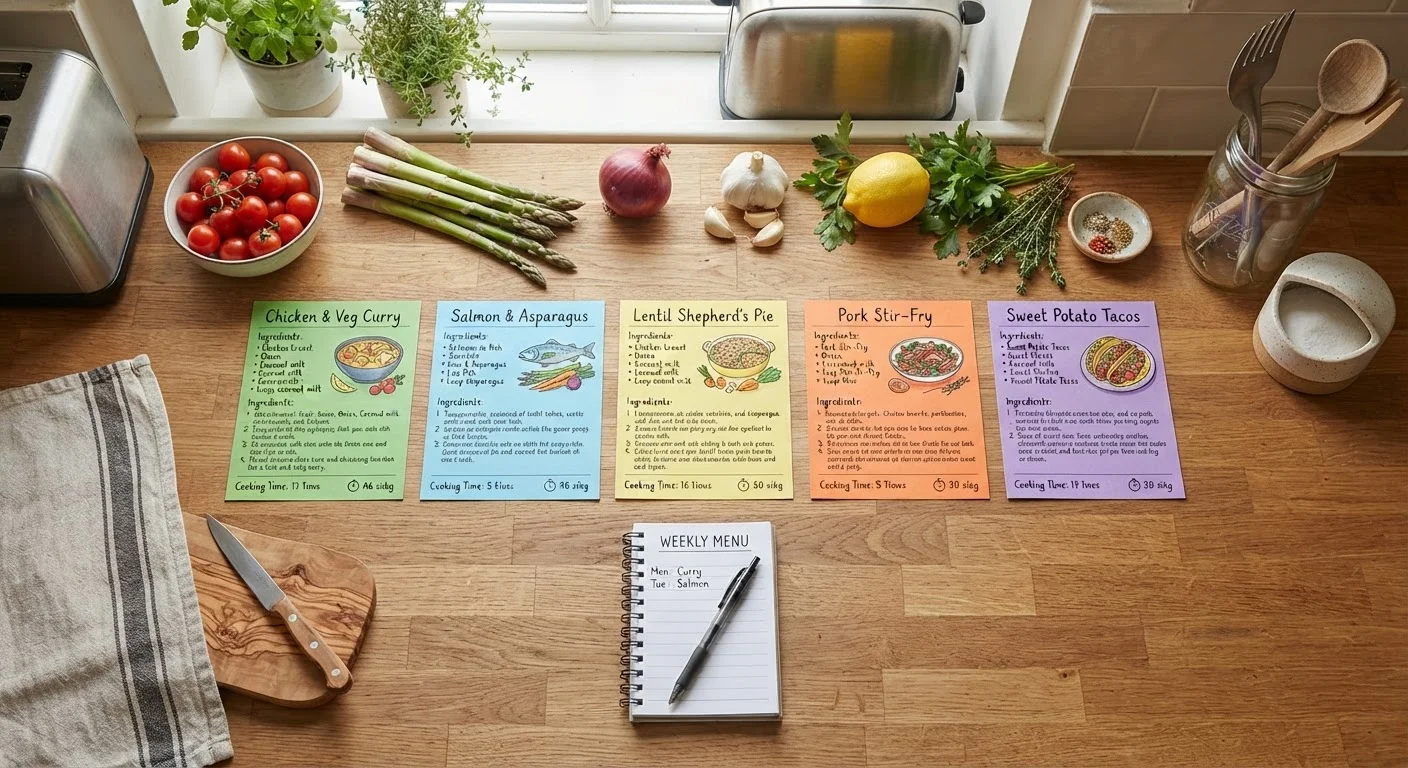
Key Takeaways
- Planning five dinners — not seven — builds in realistic flexibility for busy weeks.
- Varying protein sources across the week supports nutritional balance for all ages.
- Anchoring your plan to a repeating weekly structure makes it easier to sustain long-term.
- Batch-cooking one or two components on the weekend reduces weeknight effort significantly.
- Involving family members in the planning process improves meal acceptance and reduces waste.
What you will need
Why Five Dinners Instead of Seven
Most meal plans stumble because they aim too high. Planning seven distinct dinners assumes a perfect week — no late meetings, no takeout cravings, no birthday dinners out. A five-dinner framework acknowledges reality: two nights each week will naturally be covered by leftovers, a quick takeout, or a simple breakfast-for-dinner rotation. This is not a compromise; it is a structural advantage.
Five planned dinners also give you enough variety to hit nutritional targets across the week. Nutrition scientists consistently emphasize dietary diversity — rotating proteins, vegetables, and whole grains — as a foundation of a balanced eating pattern. Five slots are manageable to diversify without overwhelming your grocery list or your energy. For a deeper look at how to build this kind of consistent routine, see our beginner's guide to family meal planning.
Understanding why plans unravel is just as important as building them. If your household has tried planning before and stalled by midweek, this breakdown of why meal plans fail by Wednesday can help you identify and address the specific friction points in your routine.
What You'll Need Before You Start
Effective planning requires a small amount of upfront setup. Gather the following before working through the steps below.
What you will need
Weekly calendar or planner
Map each dinner to a specific evening based on how much time and energy each day allows.
Recipe reference (app, website, or cookbook)
Source the five meals you will cook, with ingredient lists you can convert into a shopping list.
Grocery list template
Organize ingredients by category (produce, proteins, pantry staples) to streamline shopping.
Meal planning app or spreadsheet
Track planned meals, repeat favorites, and build a rotating library over time.
Building Your Five-Dinner Week: Step by Step
Work through these steps once per week — ideally on a weekend morning or Sunday evening. The process becomes faster after two or three repetitions as you build a personal recipe library and a reliable grocery rhythm.
Map your week's energy levels before choosing meals
Look at your calendar for the coming week. Identify which evenings are high-pressure — long commutes, after-school activities, evening meetings — and which have more breathing room. Assign your most involved meals (those requiring 45+ minutes of active cooking) to lower-stress evenings, and reserve quick 20-to-30-minute meals or slow-cooker dinners for your busiest nights.
Select one anchor protein per dinner
For each of the five evenings, choose a primary protein. Vary these across the week — a poultry-based dish, a plant-based dinner using legumes or tofu, a fish or seafood option, an egg-based meal, and one red-meat option if your household eats it. This rotation ensures nutritional breadth and prevents the monotony that causes plans to collapse. Write all five proteins down before selecting full recipes.
Build each meal around a vegetable, not just a protein
Once you have your five proteins, pair each with at least one vegetable — ideally from different color groups across the week. Dark leafy greens, orange root vegetables, and red or yellow bell peppers each contribute distinct micronutrients. A simple pairing approach: choose one vegetable that can be roasted alongside the protein, and one that can be served fresh or lightly steamed to add variety of texture.
Identify one batch-cook component for the weekend
Choose one ingredient from your five-dinner plan that can be cooked in a large quantity on the weekend and used across multiple meals. A pot of cooked grains (brown rice, farro, or quinoa), a batch of roasted vegetables, or a simple legume preparation can anchor two or three dinners, cutting active cooking time significantly on weekday evenings.
Write a consolidated grocery list by category
With all five meals selected and your batch-cook component identified, extract every ingredient and organize your list into categories: produce, proteins, dairy or alternatives, pantry staples, and frozen items. Cross-check your pantry for existing staples before finalizing quantities. A categorized list reduces shopping time and the likelihood of missed items that derail a planned meal.
Confirm the plan with your household
Before shopping, share the five-dinner plan with whoever else eats those meals — a partner, older children, or other household members. A brief check-in surfaces any strong objections early, allows for simple swaps, and increases the likelihood meals will actually be eaten. Reducing food waste starts at the planning stage, not at the dinner table.
Start With a Rotating Template
Rather than planning from scratch each week, build a loose template: Monday is always a plant-based meal, Tuesday is poultry, Thursday is fish, and so on. This skeleton reduces decision fatigue while still leaving room to rotate specific recipes. Over time, you accumulate a personal library of reliable meals that fit each slot. For a comprehensive framework on building sustainable planning habits, see our complete family nutrition and meal planning resource.
Nutritional Variety Across the Week
A five-dinner plan gives you five opportunities to distribute nutritional value across the family. A practical rule of thumb: aim for at least three distinct protein sources across the week — for example, poultry, legumes, and fish or eggs — alongside a range of colored vegetables, which provide different micronutrient profiles. Whole grains such as brown rice, quinoa, or whole-wheat pasta are worth anchoring into at least two or three dinners.
For families with school-age children, dinner nutrition can complement what children are eating during the day. Our guide on building nutritionally complete school lunches can help you see the full daily picture. Once your five-dinner plan is drafted, run it against a structured review before shopping — the weekly meal planning checklist is designed exactly for this purpose.
Don't Over-Engineer the First Week
Families new to structured dinner planning often choose meals that are too ambitious for weeknights. Start with meals your household already knows and enjoys, then introduce one unfamiliar recipe per week. A plan that is executed successfully three weeks in a row provides more nutritional benefit than an elaborate plan abandoned by Tuesday.
This article is for general informational and educational purposes only and is not a substitute for professional medical or dietary advice. Consult a qualified healthcare provider or registered dietitian for guidance tailored to your family's specific nutritional needs.