
Digital Thermometers vs. Temporal Artery Thermometers: Which Is More Accurate?

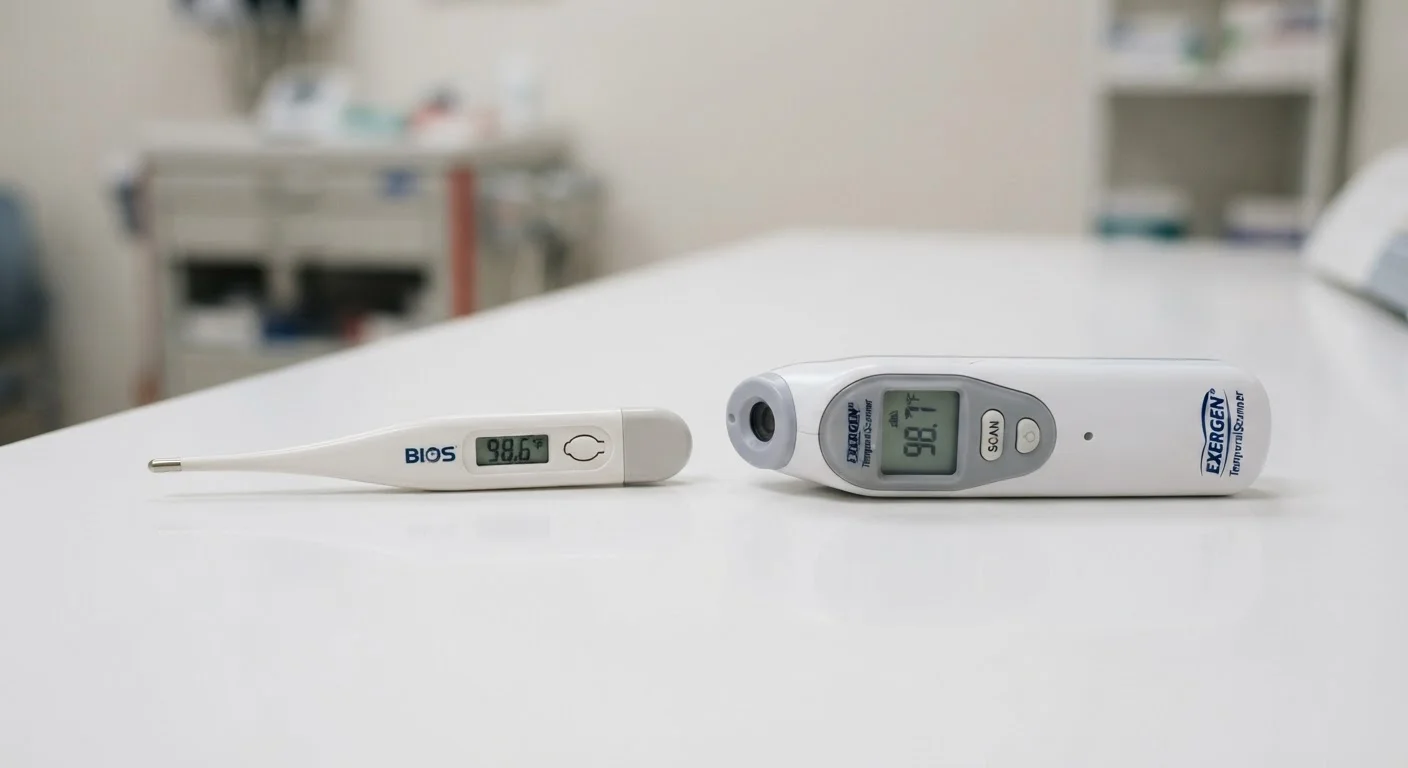
Key Takeaways
- Digital oral thermometers are highly accurate when used correctly but require patient cooperation and a closed mouth.
- Temporal artery thermometers scan the superficial temporal artery and return results in about one second.
- Both types are clinically acceptable for home use, but technique errors are the most common source of inaccurate readings.
- Temporal artery devices can underread when the forehead is wet with sweat or when used in cold environments.
- Children under 4 and infants are generally better served by temporal artery or rectal methods than oral thermometers.
- Always consult a healthcare provider if fever readings concern you, especially in infants under 3 months.
Option A
Digital Oral Thermometer
The reliable, widely trusted standard for older children and adults.
Best for: Best for cooperative patients aged 4 and older who can hold a thermometer safely under the tongue for about 30 seconds.
Option B
Temporal Artery Thermometer
The fast, non-invasive scan designed for all ages — especially young children.
Best for: Best for infants, toddlers, and anyone who needs a quick, no-contact reading without requiring stillness or cooperation.
If you have infants or toddlers at home
Temporal Artery Thermometer
Young children rarely stay still long enough for an accurate oral reading. A forehead scan takes roughly one second and requires no cooperation from the child.
If you need reliable, precise readings for older children or adults
Digital Oral Thermometer
When used correctly in cooperative patients, oral digital thermometers consistently provide accurate core-temperature estimates with minimal learning curve.
If the person being measured is heavily perspiring or has just come indoors from the cold
Digital Oral Thermometer
Sweat and environmental temperature can cause temporal artery thermometers to underestimate true temperature; oral measurement is less affected by these conditions.
If speed and minimal contact are priorities — such as during illness surges
Temporal Artery Thermometer
Forehead scanning can assess multiple family members quickly without cleaning the probe between uses in the same household.
How Each Thermometer Type Works
Understanding the technology behind each device helps explain why accuracy can vary depending on circumstances.
Digital oral thermometers use an electronic heat sensor — typically a thermistor — placed under the tongue against the sublingual artery, one of the closest accessible blood vessels to core body temperature. The sensor detects heat and converts it to an electrical signal, displaying a reading usually within 20–60 seconds. Because they measure from a well-vascularized site kept warm by the body's core circulation, they can offer a close approximation of true internal temperature when technique is sound.
Temporal artery thermometers (TATs) use infrared (IR) technology to detect heat emitted from the skin overlying the temporal artery, which runs across the forehead. When the device is swiped or held near the forehead, the IR sensor captures thermal emissions and calculates an estimated temperature. Some models also incorporate an ambient temperature correction algorithm to improve accuracy. Results appear in approximately one second.
A Note on Fever Thresholds
A fever is generally defined as a temperature at or above 100.4°F (38°C) in most clinical guidelines, though the site of measurement can slightly influence where that threshold sits. Rectal readings typically run about 0.5°F higher than oral readings, and temporal artery readings can vary. If you're unsure how to interpret a reading for your situation, your healthcare provider is the best resource.
For context on how measurement technique affects other home diagnostic readings, see our overview of home monitor accuracy factors.
Accuracy: What the Evidence Generally Shows
Both device types are considered clinically acceptable for home fever detection, but each has specific accuracy conditions and limitations.
| Criterion | Digital Oral Thermometer | Temporal Artery Thermometer |
|---|---|---|
| Measurement site | Sublingual artery (under tongue) | Temporal artery (forehead) |
| Technology | Thermistor (contact sensor) | Infrared (non-contact scan) |
| Reading time | 20–60 seconds | ~1 second |
| Suitable age range | Age 4 and older | All ages (with technique) |
| Affected by sweating | Minimally | Yes — can underread |
| Requires cooperation | Yes — closed mouth needed | Minimal — quick scan |
| Affected by recent food/drink | Yes — wait 15–30 min | No |
| Typical accuracy vs. core temp | Within ~0.5°F in correct use | Variable; environment-dependent |
Oral digital thermometers tend to perform consistently in research settings when subjects keep their mouths closed and have not consumed hot or cold beverages in the prior 15–30 minutes. Studies comparing oral readings to rectal temperature (considered the closest non-invasive proxy for core body temperature) often report mean differences within 0.5°F (0.3°C) under controlled conditions.
Temporal artery thermometers show more variability in research literature. A frequently cited concern is underestimation during diaphoresis (sweating), because evaporative cooling on the forehead lowers skin surface temperature below true arterial temperature. Cold ambient environments can produce similar effects. However, when the forehead is dry and the environment is stable, studies have found TATs to be a reasonable screening tool, particularly in pediatric settings where speed and comfort matter more than marginal precision.
For families caring for people across different life stages, appropriate device selection by age is an important consideration beyond raw accuracy statistics.
Practical Considerations by Age Group and Situation
The most accurate thermometer for your household is largely determined by who will be measured and under what conditions.
Infants (0–3 months)
Rectal thermometers remain the gold standard endorsed by major pediatric organizations for this age group. Temporal artery devices are sometimes used for quick screening but should be confirmed with rectal measurement when precise accuracy is critical. Oral thermometers are not appropriate at this stage.
Toddlers and Young Children (6 months–4 years)
Temporal artery thermometers are a practical and widely accepted option. Children this age rarely cooperate long enough for oral measurements. Tympanic (ear canal) IR thermometers are another option, though proper ear canal positioning can be difficult with young children.
Children (4+) and Adults
Either device is appropriate. Oral thermometers provide dependable results when the patient can breathe through their nose and hasn't eaten or drunk anything for 15 minutes. TATs remain convenient for repeated checks during illness.
Women using basal body temperature (BBT) for cycle tracking should note that oral thermometers taken immediately upon waking are the standard tool for that purpose — temporal artery devices are generally not validated for BBT protocols. See what cycle-tracking methods actually measure for more detail.
~0.5°F
Typical oral vs. rectal temperature difference
Clinical literature generally places oral temperature readings approximately 0.3–0.5°F lower than simultaneously obtained rectal readings in healthy adults.
1 second
Average temporal artery scan time
Most infrared temporal artery thermometers are designed to produce a reading in approximately one second, according to manufacturer specifications and clinical evaluation studies.
100.4°F
Standard fever threshold across measurement sites
The American Academy of Pediatrics and other major health bodies define fever as a temperature at or above 100.4°F (38°C), regardless of measurement method.
This article is for informational purposes only and is not a substitute for professional medical advice. Always consult a qualified healthcare provider regarding fever management, especially for infants under 3 months, individuals with chronic conditions, or any situation causing concern.