

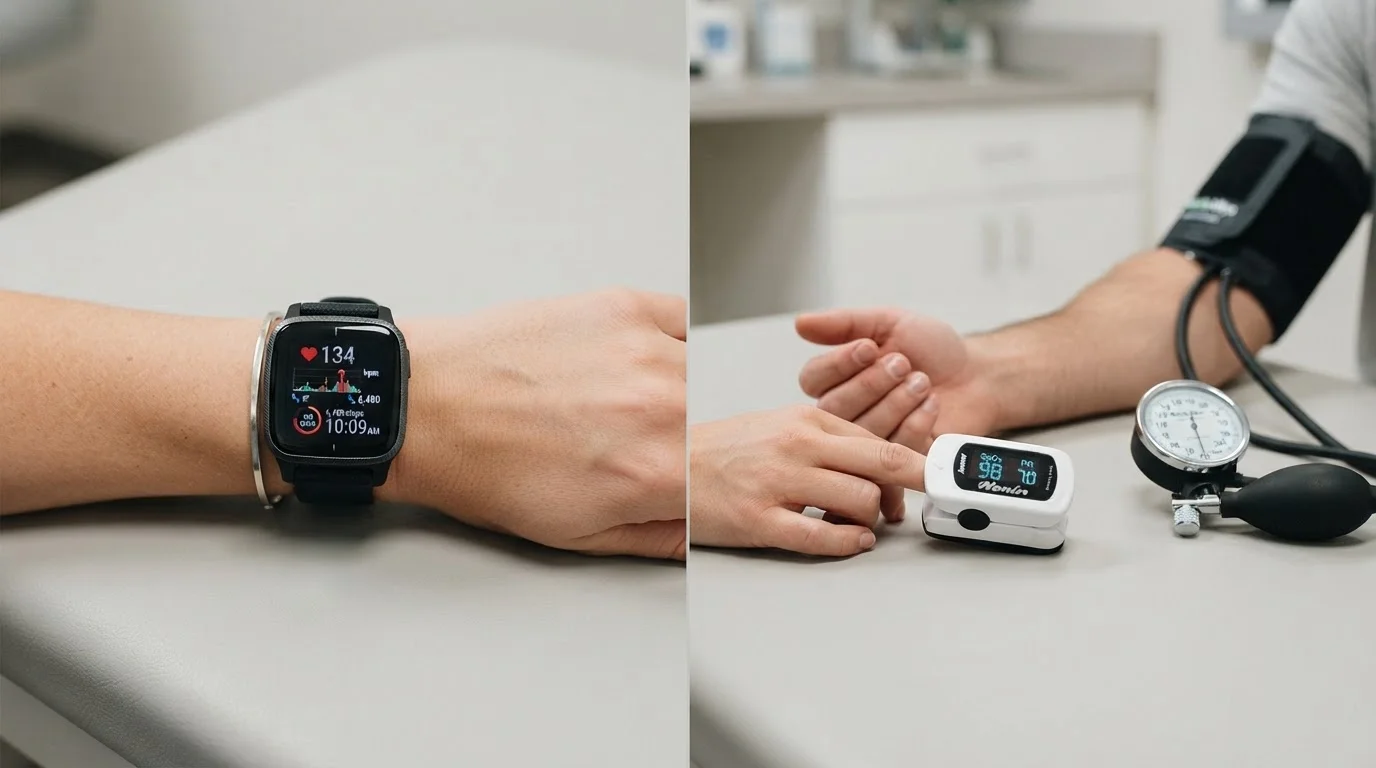
Key Takeaways
- Consumer fitness trackers are designed for wellness trends, not clinical diagnosis.
- Medical-grade devices meet regulatory accuracy standards that most wearables do not.
- Heart rate and SpO2 readings from wearables can differ meaningfully from clinical measurements.
- Wearable data can be a useful conversation starter with a clinician, but not a substitute for evaluation.
- Understanding which device to trust — and when — helps families avoid acting on misleading readings.
Our Verdict
Consumer fitness trackers excel at motivating activity and spotting broad wellness patterns over time, but they are not validated replacements for clinical measurement tools when health decisions are at stake. Medical-grade monitors carry regulatory clearance and documented accuracy that consumer wearables generally do not meet. Use each for what it was designed to do.
| Best for | Recommended |
|---|---|
| Tracking daily activity, sleep trends, and general fitness goals | Consumer Fitness Tracker |
| Managing a diagnosed condition or informing clinical decisions | Medical-Grade Monitor |
| Spotting changes that prompt a conversation with a clinician | Consumer Fitness Tracker (as a trigger, not a diagnosis) |
| Generating data for a healthcare provider to review | Medical-Grade Monitor |
How Consumer Wearables Measure Health Metrics
Most consumer fitness trackers use a technology called photoplethysmography (PPG) — a light-based method where small LEDs shine through the skin and sensors detect how much light is absorbed by blood vessels. Changes in absorption correspond to blood flow, which the device translates into heart rate estimates. Some wearables extend this to estimate blood oxygen saturation (SpO2) using red and infrared light.
The key word is estimate. PPG readings are inherently susceptible to motion artefacts (interference caused by movement), skin tone variation, ambient light, and how snugly the device sits on the wrist. Wearable manufacturers typically optimize for comfort and battery life, which means sensor placement and contact pressure are compromises rather than clinical ideals.
For a broader look at how home monitoring devices generally work, see our family guide to home health monitoring devices.
Wearable Data Is a Starting Point
If your fitness tracker shows an unusual reading — an elevated resting heart rate, a low SpO2, or an irregular rhythm alert — treat it as a reason to follow up, not a diagnosis. Bring the data to your clinician and pair it with a validated measurement. Pattern changes over days or weeks are generally more meaningful than any single reading.
What Makes a Device "Medical-Grade"?
In the United States, medical-grade monitoring devices are subject to review by the Food and Drug Administration (FDA). A device cleared through the FDA's 510(k) pathway, for example, has been evaluated against a predicate device with documented clinical accuracy. This means manufacturers must demonstrate — through validated testing protocols — that their device consistently measures within defined error margins compared to a reference standard.
Clinical pulse oximeters, for instance, are typically validated against arterial blood gas analysis (a direct laboratory measurement of blood oxygen). FDA-cleared blood pressure monitors must demonstrate accuracy within ±5 mmHg mean difference against an auscultatory reference. Consumer wearables are frequently marketed as wellness tools, which places them under a different — and generally less demanding — regulatory category.
| Consumer Fitness Tracker | Medical-Grade Monitor | |
|---|---|---|
| Regulatory standard | Wellness/general wellness category | FDA clearance or approval required |
| Heart rate accuracy | Good at rest, reduced during movement | Validated against clinical reference |
| SpO2 measurement | Estimated, less reliable at low saturation | Validated against arterial blood gas |
| Blood pressure | Cuffless algorithms, not broadly validated | Cuff-based, validated to ±5 mmHg standard |
| Primary intended use | Wellness trends and activity tracking | Clinical monitoring and diagnosis support |
| Appropriate for clinical decisions | No — use as a prompt to seek evaluation | Yes — when properly used and calibrated |
It is worth noting that some wearable manufacturers are actively pursuing FDA clearance for specific features. When a particular feature on a consumer device carries explicit FDA clearance, that feature has met a clinical accuracy standard — but this does not automatically extend to all readings the device produces.
Where the Data Gap Actually Shows Up
Research published in peer-reviewed journals has consistently found that wrist-worn PPG devices can show clinically meaningful discrepancies in SpO2 readings compared to validated pulse oximeters — particularly at lower oxygen saturation levels, which is precisely when accurate readings matter most. For heart rate, accuracy tends to be better at rest than during exercise, when motion artefacts are highest.
Blood pressure is another area where the gap is significant. True blood pressure measurement requires occluding arterial blood flow with a cuff — a physical process. Wearables that estimate blood pressure without a cuff use algorithms that have not yet achieved broad clinical validation, and most carry disclaimers stating they are not intended to replace traditional measurement.
Families who rely on wearable readings to manage conditions such as hypertension, heart arrhythmias, or respiratory illness risk acting on data that may not reflect clinical reality. The home monitoring myths article covers common misconceptions — including the assumption that a higher price tag guarantees clinical accuracy.
Using Wearable Data Wisely
This does not mean fitness trackers are without value. Long-term trend data — a sustained elevation in resting heart rate, disrupted sleep patterns, or a drop in daily activity — can surface changes worth discussing with a clinician. Wearables are best understood as pattern-detection tools, not diagnostic instruments.
A practical framework: use wearable data to notice, not to conclude. If your tracker flags an unusual reading, that is a reason to follow up with a validated device or a healthcare provider — not a reason to alter medications, restrict activity, or dismiss symptoms. Before logging or acting on any home reading, review the home monitor accuracy checklist to rule out technique and environmental factors.
For those building a monitoring routine around a chronic condition, see how to build a home monitoring routine that supports your care team.
This article is for informational purposes only and does not constitute medical advice. Always consult a qualified healthcare professional regarding personal health conditions, symptoms, or monitoring needs.