
Upper-Arm vs. Wrist Blood Pressure Cuffs: Understanding the Accuracy Difference

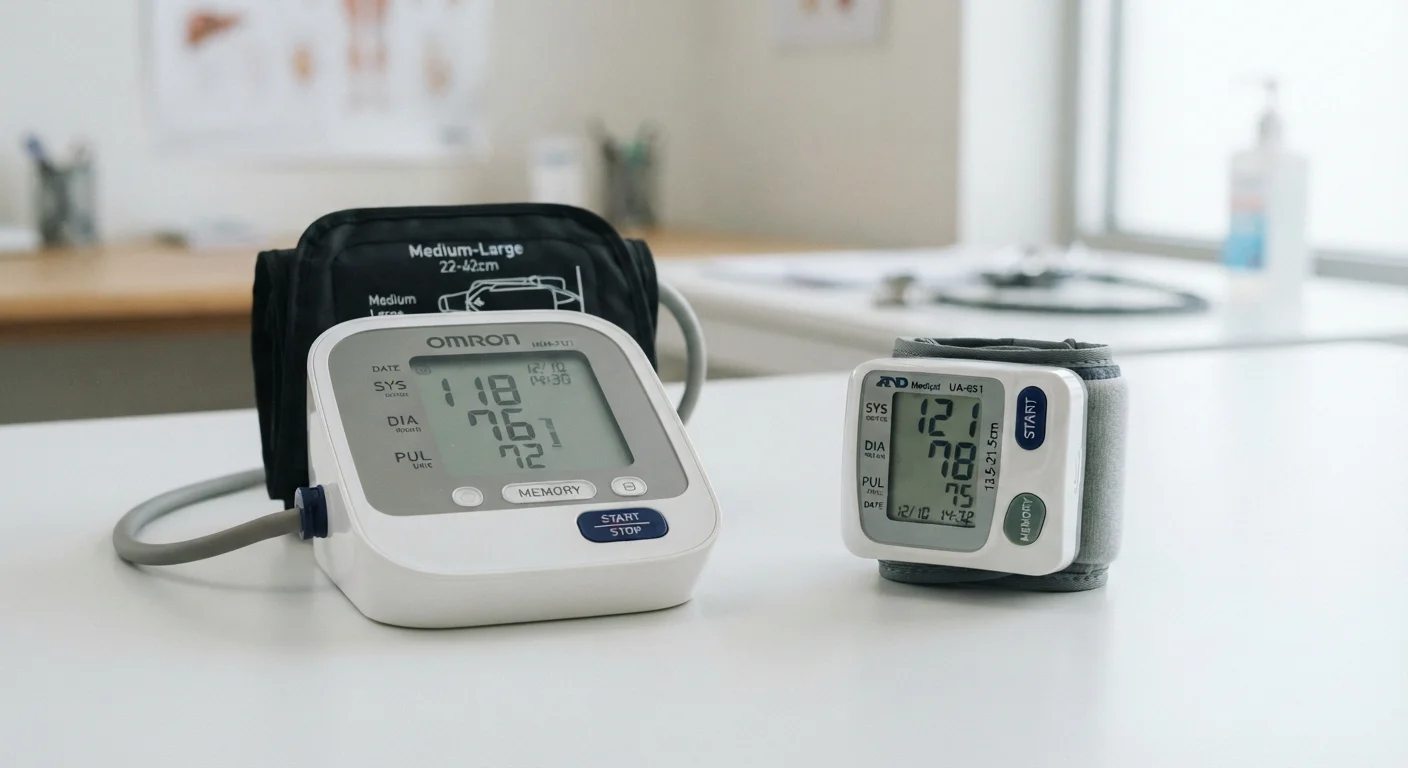
Key Takeaways
- Upper-arm cuffs are generally recommended by major health organizations as the more accurate option for home monitoring.
- Wrist cuffs are highly sensitive to positioning errors, which can cause readings to vary significantly.
- Cuff size and fit matter for both types — an ill-fitting cuff produces unreliable results regardless of placement.
- Both cuff types should carry a validated accuracy certification before use for health tracking.
- Wrist cuffs may suit people with certain arm conditions, but only when used with careful technique.
- Always share home readings with your healthcare provider to interpret what the numbers mean for you.
Option A
Upper-Arm Blood Pressure Cuff
The clinical standard for home blood pressure monitoring.
Best for: Most adults seeking readings that align closely with clinical measurements, especially those managing hypertension.
Option B
Wrist Blood Pressure Cuff
The compact, convenient alternative for on-the-go monitoring.
Best for: People who find upper-arm cuffs uncomfortable or impractical and can maintain strict positioning technique.
If you are monitoring blood pressure regularly for a known condition
Upper-Arm Blood Pressure Cuff
Upper-arm monitors closely replicate clinical measurement conditions, making trends easier for your provider to interpret alongside office readings.
If you travel frequently and need a portable monitor
Wrist Blood Pressure Cuff
Wrist cuffs are compact and lightweight, making them more practical when portability is essential — provided you use them with careful positioning.
If you have large arms or find standard cuffs uncomfortable
Upper-Arm Blood Pressure Cuff
Many upper-arm monitors offer extended or wide-range cuffs, making accurate fit achievable for a broader range of arm sizes.
If you have a condition affecting blood flow to the upper arm
Wrist Blood Pressure Cuff
In specific circumstances where upper-arm measurement is contraindicated, a wrist monitor may be appropriate — always follow your doctor's guidance.
Why Cuff Placement Affects Accuracy
Blood pressure monitors measure the force blood exerts against artery walls by detecting pressure changes in an inflatable cuff. Where that cuff sits relative to the heart is central to getting a reliable reading. Blood pressure is not uniform throughout the body — it changes as blood travels further from the heart through progressively smaller vessels.
The upper arm sits close to heart level and contains the brachial artery, the same vessel clinicians use during manual measurements with a stethoscope and sphygmomanometer (the traditional mercury or aneroid gauge device). This anatomical consistency is why upper-arm readings are considered the clinical reference standard.
The wrist, by contrast, sits further from the heart and relies on the radial and ulnar arteries — smaller vessels where blood pressure values can differ from brachial readings. Wrist devices must compensate for this difference, and any deviation in wrist height relative to the heart amplifies measurement error. Even a wrist held a few centimetres too low or high can shift a reading by several millimetres of mercury (mmHg).
For a detailed look at what your readings actually indicate, see what the numbers on your home blood pressure monitor mean.
| Criterion | Upper-Arm Cuff | Wrist Cuff |
|---|---|---|
| Measurement site | Brachial artery | Radial/ulnar arteries |
| Clinical recommendation | Preferred by major health bodies | Acceptable with strict technique |
| Sensitivity to positioning | Moderate — arm at heart level | High — wrist must be at heart level |
| Portability | Bulkier, less travel-friendly | Compact and lightweight |
| Ease of self-application | May be harder solo | Generally easier to apply alone |
| Cuff size options | Wide range, including large-arm sizes | Limited by wrist circumference range |
| Validated device availability | Many validated options available | Fewer validated options |
Accuracy, Validation, and What Health Organizations Say
Several independent bodies — including the American Heart Association (AHA) and the British and Irish Hypertension Society (BIHS) — publish validated device lists based on standardized clinical testing protocols. A monitor described as validated has passed rigorous comparison testing against a reference standard, not just manufacturer self-testing.
The AHA generally recommends upper-arm monitors for home use, citing their superior accuracy under real-world conditions where users may not maintain perfect technique. Wrist monitors can produce validated readings, but only when held at heart level — a position that requires conscious effort and is easy to get wrong.
~5 mmHg
Typical error from wrist position deviation
Research has shown wrist blood pressure readings can shift by approximately 5 mmHg or more when the wrist is held just slightly above or below heart level.
~70–80%
Adults who use incorrect cuff technique
Studies suggest a substantial majority of home monitor users make at least one positioning or preparation error that can affect reading accuracy.
Wrist monitors are not inherently inaccurate, but their accuracy is far more dependent on user technique. Studies comparing the two have consistently found that wrist readings show greater variability when positioning is not precisely controlled. For families tracking blood pressure over time, this variability can obscure meaningful trends or create false concern.
Before relying on any home monitor, check whether it appears on a validated device list from a recognized organization. Validation status is separate from brand recognition or price point.
Practical Considerations for Families
Choosing between an upper-arm and wrist cuff often comes down to a combination of clinical guidance and practical reality. Here are the key factors to weigh:
- Cuff fit: An upper-arm cuff must match the circumference of your arm — most monitors specify a range (e.g., 22–42 cm). Using the wrong size is one of the most common sources of error, regardless of cuff type.
- Ease of use: Wrist monitors are simpler to apply solo, which may matter for people with limited hand mobility. However, some devices now include positioning guides or sensors that alert users when the wrist is not at heart level.
- Irregular heart rhythms: People with atrial fibrillation (AFib) or other arrhythmias should discuss device selection with their provider — oscillometric wrist devices may produce less reliable readings in these cases.
- Special populations: Children, pregnant individuals, and older adults with arterial stiffness may need specific device types or professional guidance on which readings to trust. Consulting a healthcare professional is strongly recommended for these groups.
For practical tips on positioning, timing, and avoiding common mistakes, see how to get an accurate blood pressure reading at home. And if your home readings consistently differ from what your doctor records, why home and clinic readings sometimes diverge explains the key factors behind that gap.
This article is for general informational purposes only and does not constitute medical advice. Always consult a qualified healthcare professional before making decisions about blood pressure monitoring or management.