

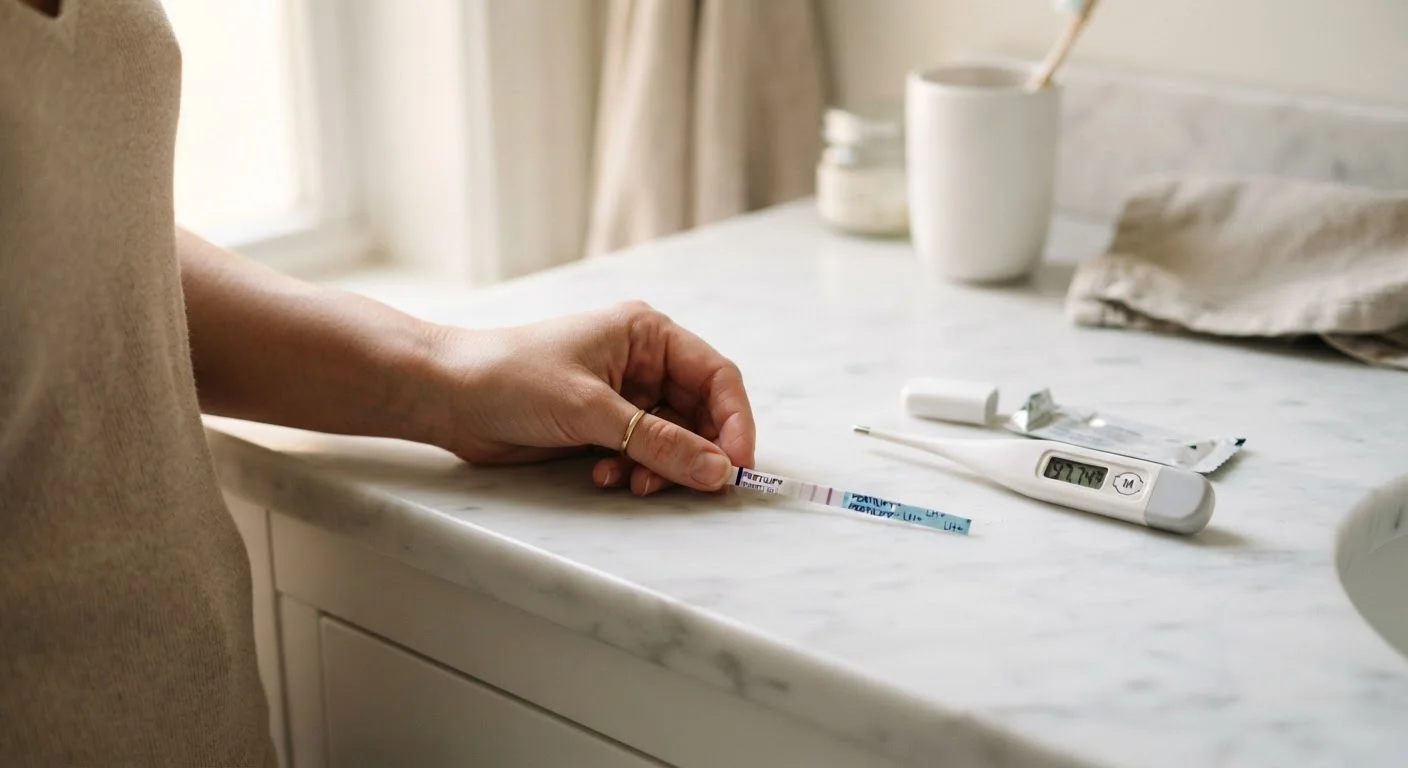
Key Takeaways
- No single ovulation tracking method is 100% accurate for all women in all cycles.
- LH urine tests detect a hormonal surge but cannot confirm that ovulation actually occurred.
- Basal body temperature rises after ovulation, making it a retrospective rather than predictive tool.
- Cervical mucus changes are a direct hormonal sign but require consistent daily observation to interpret.
- Combining two or more methods generally improves reliability over any single approach.
- Women with irregular cycles, PCOS, or perimenopause may find standard tracking less predictive.
Our Verdict
Each ovulation tracking method captures a different physiological signal, and each carries its own accuracy limitations. For most women with regular cycles, combining LH testing with basal body temperature charting offers the clearest window into the fertile phase. Women with irregular cycles or underlying hormonal conditions should work with a healthcare provider to interpret results appropriately.
| Best for | Recommended |
|---|---|
| Those wanting advance notice of the fertile window | LH urine testing (ovulation predictor kits) |
| Those who prefer a low-cost, medication-free approach | Basal body temperature charting |
| Those seeking a hormone-free, whole-body awareness method | Cervical mucus observation (Billings/creighton) |
| Those with irregular cycles or suspected hormonal conditions | Clinical monitoring (ultrasound and blood tests) |
Why Ovulation Tracking Matters
Ovulation — the release of a mature egg from the ovary — defines the fertile window in each menstrual cycle. Because an unfertilized egg survives only 12 to 24 hours after release, accurately identifying ovulation is central to both conception planning and certain fertility-awareness-based contraceptive approaches. Yet the biology is more variable than many people expect. Cycles differ between individuals and from month to month within the same person, which means calendar math alone is rarely sufficient.
Understanding how each tracking method works — and what it actually measures — helps set realistic expectations. If you are trying to conceive, see our preconception preparation guide for a broader framework of considerations beyond cycle timing.
This article provides general health information only and is not a substitute for personalized medical advice. Always consult a qualified healthcare provider regarding your reproductive health.
Comparing the Main Ovulation Tracking Methods
Four approaches dominate evidence-based ovulation tracking: basal body temperature (BBT) charting, luteinizing hormone (LH) urine testing, cervical mucus observation, and clinical monitoring. Each targets a different physiological signal, and each has distinct strengths and limitations.
| BBT Charting | LH Urine Testing | Cervical Mucus | Clinical Monitoring | |
|---|---|---|---|---|
| What it measures | Post-ovulation temperature rise | Pre-ovulation LH surge | Estrogen-driven mucus changes | Follicle growth and hormone levels |
| Timing relative to ovulation | Retrospective (after) | Predictive (24–36 hrs before) | Predictive (1–2 days before) | Real-time confirmation |
| Cost | Low (thermometer only) | Moderate (test strips) | None | High (clinical visit required) |
| Ease of use | Moderate — daily habit needed | Moderate — timing sensitive | Requires learning period | Performed by clinician |
| Confirms ovulation occurred | Indirectly (temperature shift) | No | No | Yes (ultrasound/progesterone) |
| Reliability with irregular cycles | Limited | Reduced (e.g., PCOS) | Variable | Most reliable |
For a broader look at what cycle-monitoring approaches actually measure day to day, see tracking your cycle: what different methods can and cannot tell you.
Basal Body Temperature: A Retrospective Signal
Basal body temperature is the body's resting temperature, measured immediately upon waking before any activity. After ovulation, rising progesterone causes a sustained temperature increase of approximately 0.2–0.5°C (0.4–1.0°F) that persists until the next period. Consistent charting over several cycles allows a woman to identify a pattern — but the rise confirms that ovulation has already occurred, not that it is imminent.
BBT is highly sensitive to disruptions: illness, alcohol, poor sleep, shift work, and even ambient room temperature can alter readings. For this reason, BBT alone is most useful as a retrospective tool for understanding typical cycle patterns rather than for predicting the fertile window in real time.
Improve BBT Accuracy With Consistent Habits
Take your temperature at the same time each morning, after at least three consecutive hours of sleep, before getting out of bed or drinking anything. Use a dedicated basal thermometer that reads to two decimal places. Note any disruptions — illness, travel, late nights — directly on your chart so you can account for outlier readings rather than misinterpreting them.
LH Urine Testing: Predictive but Not Confirmatory
Ovulation predictor kits (OPKs) detect the surge in luteinizing hormone (LH) that the pituitary gland releases roughly 24 to 36 hours before ovulation. A positive result signals that the LH surge is underway, giving a narrow predictive window.
However, a positive OPK does not confirm that ovulation followed. In conditions such as polycystic ovary syndrome (PCOS), LH levels may be persistently elevated or surge without triggering egg release, producing misleading results. Additionally, the surge can be brief — sometimes under 10 hours — meaning once-daily testing may miss it entirely. Testing twice daily around the expected fertile window reduces this risk. For context on interpreting hormone measurements more broadly, see common misreadings of hormone test results.
Cervical Mucus and Clinical Monitoring
As estrogen rises toward ovulation, cervical mucus transitions from scanty and thick to abundant, clear, and stretchy — often described as resembling raw egg white. This change reflects peak fertility and typically precedes ovulation by one to two days. Observing and recording mucus daily requires consistency and a learning period, but the method carries no cost and uses a direct hormonal signal. Structured approaches such as the Billings Ovulation Method or the Creighton Model provide systematic frameworks for observation and interpretation.
Clinical monitoring — transvaginal ultrasound to visualize follicle growth and blood tests measuring estradiol and progesterone — offers the most objective confirmation of ovulation but is reserved for clinical fertility workups rather than routine home use.
If a positive ovulation window is followed by a missed period, understanding how at-home pregnancy tests detect hCG can help you interpret results accurately.
Accuracy Limitations and Special Populations
No tracking method performs equally well across all populations. Women with irregular cycles, thyroid disorders, hyperprolactinemia, or PCOS often see inconsistent signals that can mislead standard interpretation. Perimenopause introduces further variability as hormone patterns shift unpredictably.
~25%
Cycles with cycle length variation
Research published in reproductive epidemiology journals estimates that a substantial minority of cycles deviate significantly from an individual's average length, complicating calendar-based prediction.
24–36 hrs
LH surge lead time before ovulation
The American College of Obstetricians and Gynecologists (ACOG) notes that the LH surge typically precedes ovulation by approximately 24 to 36 hours in ovulatory cycles.
12–24 hrs
Viable lifespan of a released egg
According to established reproductive physiology, an unfertilized oocyte remains viable for only 12 to 24 hours after ovulation, underscoring the narrow window for fertilization.
Apps and wearable devices that predict ovulation using algorithms should be understood as tools that apply population-level statistics to individual data — they do not directly measure hormones or physiological markers unless paired with compatible test hardware. Their accuracy varies considerably with cycle regularity.
Combining BBT charting with LH testing and cervical mucus observation — sometimes called the sympto-thermal method — generally provides more reliable identification of the fertile window than any single method alone. For those exploring contraception rather than conception, hormonal contraception options offers a factual overview of evidence-based alternatives.
Anyone experiencing consistently irregular cycles, absent periods, or difficulty conceiving after several months of timed intercourse should seek evaluation from a reproductive endocrinologist or gynecologist rather than relying solely on home tracking tools.