

Key Takeaways
- Nebulizers convert liquid medication into a fine mist breathed in over several minutes; inhalers deliver a measured dose in a single coordinated breath.
- Both devices require a prescription for most respiratory medications — the device choice depends on patient age, ability, and clinical need.
- Inhalers are more portable and faster; nebulizers require no breath coordination, making them valuable for very young or severely symptomatic patients.
- Proper cleaning and maintenance of either device is essential to prevent infection and ensure medication is delivered correctly.
- Always consult a healthcare provider to determine which delivery method is appropriate for your or your family member's condition.
Option A
Nebulizer
The slower, hands-free option for delivering aerosolized medication.
Best for: Best for young children, older adults, or anyone who has difficulty coordinating breath with a device.
Option B
Inhaler
The compact, portable standard for on-the-go airway medication.
Best for: Best for school-age children and adults who can coordinate a controlled breath and need a convenient, portable option.
If coordinating a breath with a device is difficult
Nebulizer
Nebulizers require only normal, relaxed breathing, making them suitable for infants, toddlers, and anyone in respiratory distress who cannot time an inhalation reliably.
If portability and speed matter most
Inhaler
Inhalers fit in a pocket and deliver a dose in seconds, making them ideal for managing symptoms at school, work, or while traveling.
If a child under 4 needs regular respiratory medication
Nebulizer
Young children generally cannot achieve the breath coordination inhalers require; nebulizers with a fitted mask deliver medication more reliably at this age.
If an older adult manages a chronic respiratory condition independently
Inhaler
With proper training and a spacer device, most adults can use inhalers effectively; they also reduce treatment session time considerably.
If a high medication dose or multiple medications are needed simultaneously
Nebulizer
Nebulizers can accommodate larger liquid volumes and, in some cases, mixed medications as directed by a clinician — an option not available with standard inhalers.
How Each Device Works
Both nebulizers and inhalers are drug delivery devices — their job is to get inhaled medication past the upper airway and into the lungs, where it acts directly on the airways. Despite sharing that goal, the mechanics are quite different.
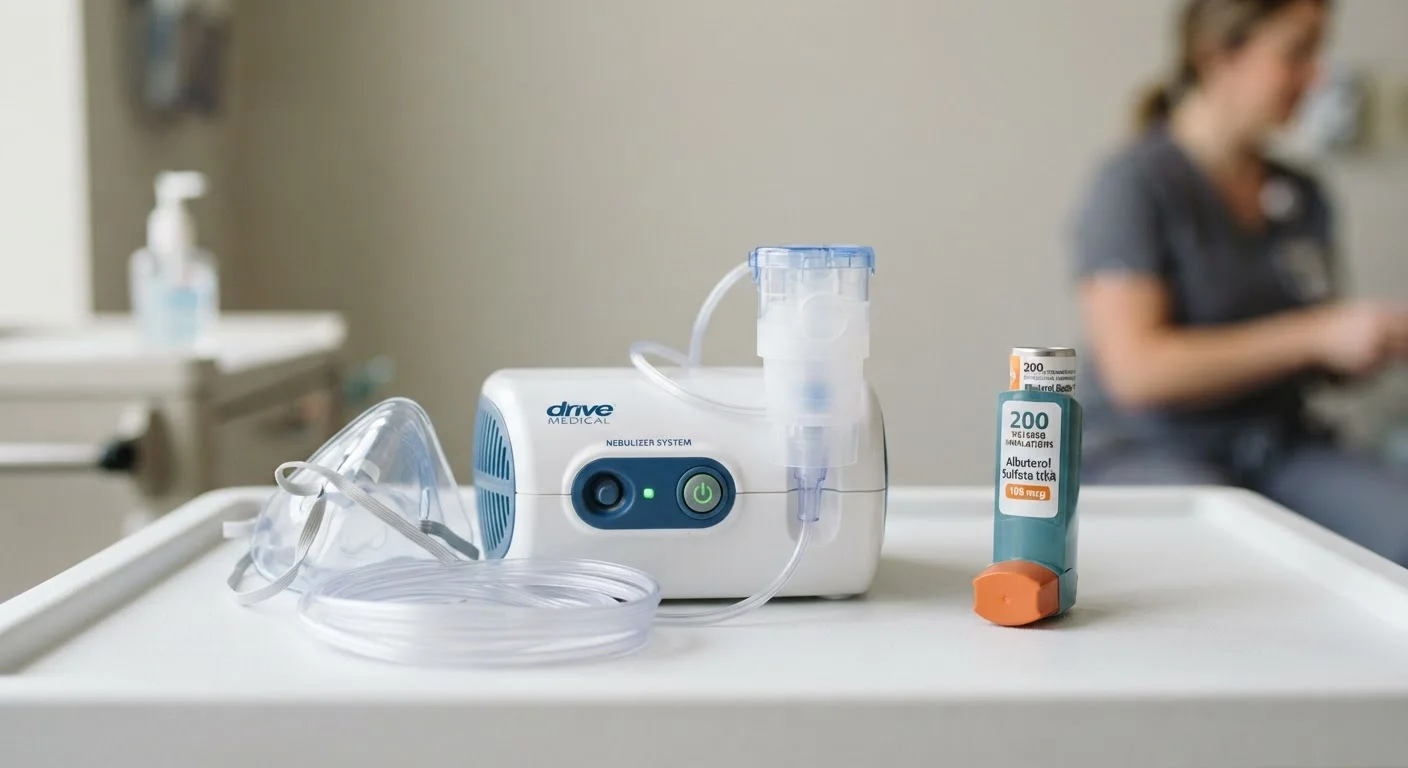
A nebulizer uses either compressed air (jet nebulizer) or ultrasonic vibration (mesh or ultrasonic nebulizer) to turn a liquid medication solution into a continuous fine mist. The patient breathes this mist through a mouthpiece or fitted mask over a treatment session that typically lasts 10–20 minutes. Because normal, relaxed breathing is all that is required, nebulizers are particularly well suited to very young children, older adults, and anyone experiencing significant breathing difficulty. For practical guidance on setting one up at home, see setting up a nebulizer safely for a child.
An inhaler — most commonly a metered-dose inhaler (MDI) or a dry-powder inhaler (DPI) — delivers a pre-measured dose of medication in a single, controlled breath. MDIs release a propellant-driven aerosol, while DPIs use the patient's own inspiratory force to draw in powdered medication. Both require deliberate breath timing: the patient must inhale at the right moment and with sufficient force to pull the medication deep into the lungs. A spacer — a hollow chamber attached between the MDI and the mouth — helps reduce the coordination required and is frequently recommended for children and adults who struggle with technique.
| Criterion | Nebulizer | Inhaler |
|---|---|---|
| Mechanism | Converts liquid to continuous mist | Releases a measured aerosol or powder dose |
| Breath coordination required | None — normal breathing is sufficient | Yes — timed inhalation required (spacer reduces this) |
| Typical treatment time | 10–20 minutes per session | Seconds per dose |
| Portability | Low — requires power source, bulky | High — pocket-sized, no power needed |
| Best age suitability | Infants, toddlers, and all ages in distress | School-age children through adults |
| Maintenance | Regular cleaning of cup, mask, and tubing required | Mouthpiece cleaning; spacer cleaning if used |
| Typical setting | Home or clinical — especially acute care | Home, school, work, travel |
Clinical Considerations: Who Uses What and Why
The choice between a nebulizer and an inhaler is not simply a matter of preference — it is a clinical decision made in consultation with a healthcare provider, based on the patient's age, diagnosis, severity of symptoms, and ability to use the device correctly.
~25 million
Americans living with asthma
According to the CDC, approximately 25 million people in the United States have asthma, making inhaled therapy one of the most commonly used medication delivery routes.
~50%
Inhaler users with incorrect technique
Research published in peer-reviewed respiratory journals consistently estimates that close to half of inhaler users demonstrate incorrect technique, underscoring the importance of device training.
Under 5
Age group most reliant on nebulizers
Clinical guidelines from organizations such as the Global Initiative for Asthma (GINA) note that children under 5 generally cannot use standard inhalers reliably without a mask and spacer or a nebulizer.
Common respiratory conditions managed with inhaled medication include asthma, chronic obstructive pulmonary disease (COPD), and certain respiratory infections. Medication classes delivered this way include bronchodilators (which relax and open the airways) and corticosteroids (which reduce airway inflammation).
In clinical settings such as emergency rooms, nebulizers are often used during acute exacerbations because patients in severe distress cannot coordinate an inhaler breath. At home, however, inhalers are generally the first-line recommendation for stable, well-controlled conditions in patients who can use them correctly — they are faster, produce less waste, and do not require an electrical supply or bulky equipment.
Older adults face unique factors worth discussing with a clinician, including hand strength, dexterity, and cognitive changes that may affect consistent device use. Our companion resource on therapeutic devices for older adults covers these considerations in more detail.
Medications used in both devices are typically prescription-only. For a broader explanation of how prescription requirements work, see over-the-counter vs. prescription medications.
This article is for informational purposes only and is not a substitute for professional medical advice. Always consult a qualified healthcare provider for guidance on respiratory conditions and appropriate treatment devices.