

Key Takeaways
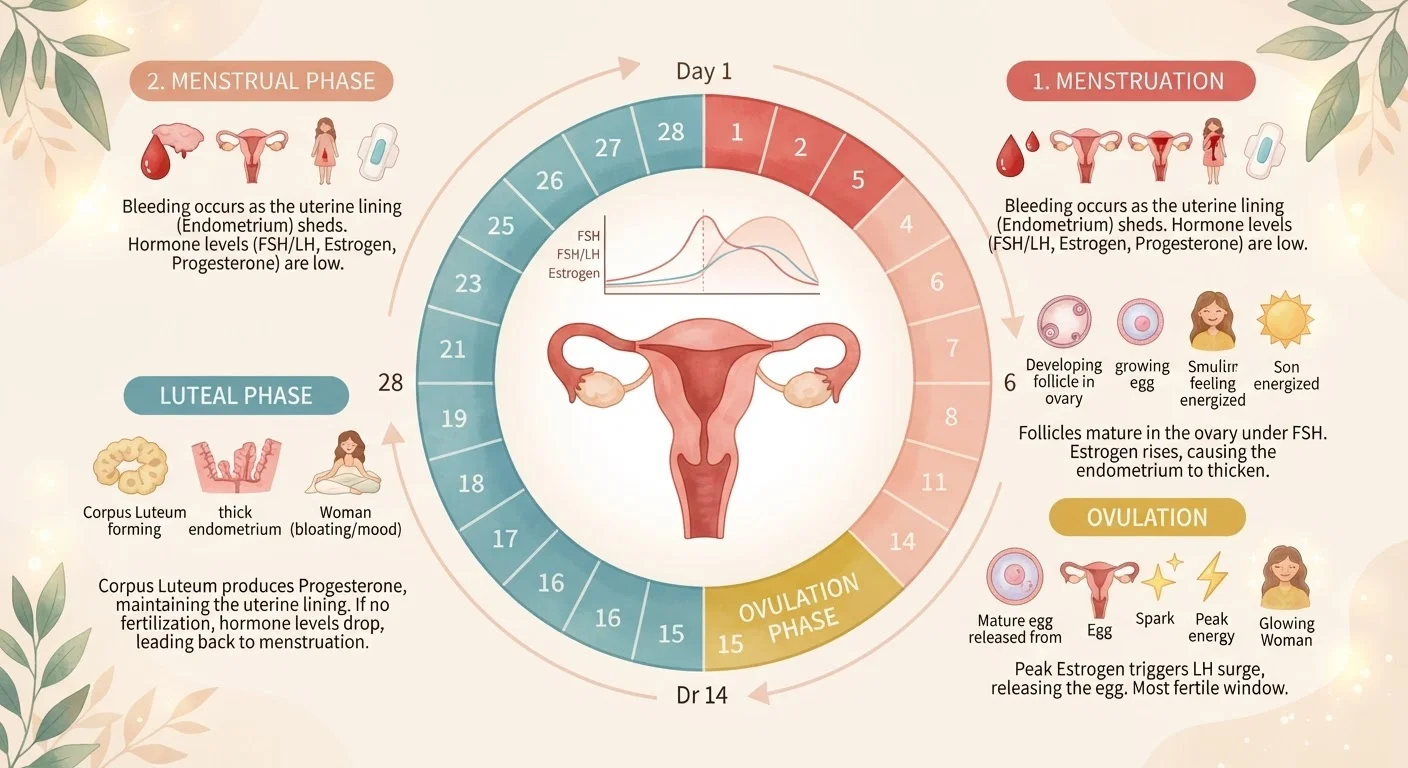
- The menstrual cycle consists of four distinct phases: menstrual, follicular, ovulatory, and luteal.
- Four hormones — FSH, LH, estrogen, and progesterone — drive each phase in sequence.
- Ovulation, which occurs around the midpoint of the cycle, is the only time conception is possible.
- Cycle length and symptom patterns vary widely among individuals and across a lifetime.
- Significant changes in cycle regularity, flow, or pain are worth discussing with a healthcare provider.
The Menstrual Cycle
The menstrual cycle is a monthly hormonal process that prepares the body for a potential pregnancy. It begins on the first day of menstruation and ends the day before the next period starts. The cycle is regulated by four key hormones — estrogen, progesterone, follicle-stimulating hormone (FSH), and luteinizing hormone (LH) — working in a precise, coordinated sequence.
A typical cycle ranges from 21 to 35 days; cycles outside this range may warrant evaluation by a healthcare provider, as they can sometimes indicate underlying hormonal or reproductive conditions.
Phase 1: The Menstrual Phase
The cycle begins with menstruation — the shedding of the uterine lining (endometrium) built up during the previous cycle. This happens when estrogen and progesterone levels drop, signaling the body that implantation of a fertilized egg has not occurred. Bleeding typically lasts between 3 and 7 days.
During this phase, the pituitary gland begins releasing small amounts of FSH, quietly initiating the next round of follicle development in the ovaries. Menstruation is both an ending and a biological reset.
Cycle Length Varies — And That's Normal
The 28-day cycle is a statistical average, not a universal standard. Research shows that a significant proportion of cycles fall outside this length even in otherwise healthy individuals. Factors such as age, stress, body weight, and underlying health conditions can all influence cycle regularity. What matters most is understanding your own baseline pattern and noting changes from it.
Phase 2: The Follicular Phase
Overlapping with menstruation and continuing beyond it, the follicular phase is defined by rising FSH levels stimulating the ovaries to develop a group of fluid-filled sacs called follicles. Each follicle contains an immature egg. Typically, one dominant follicle emerges and continues to grow while the others are reabsorbed.
As the dominant follicle matures, it produces increasing amounts of estrogen. Rising estrogen thickens the uterine lining in preparation for potential implantation and, crucially, triggers the LH surge that sets the next phase in motion. Energy, mood, and cognitive sharpness often improve during the follicular phase as estrogen climbs.
To understand how these hormonal patterns interact across a lifetime, see our overview of hormonal health from puberty to post-menopause.
21–35 days
Normal menstrual cycle length range
According to the American College of Obstetricians and Gynecologists (ACOG), this range encompasses the majority of healthy adult cycles.
~7–8 years
Average diagnostic delay for endometriosis
Research published in peer-reviewed reproductive health journals consistently documents multi-year delays between symptom onset and endometriosis diagnosis.
90%
Women who experience some PMS symptoms
The Office on Women's Health (U.S. Department of Health & Human Services) estimates the vast majority of menstruating individuals experience at least some premenstrual symptoms.
Phase 3: The Ovulatory Phase
Ovulation is the cycle's central event. A sharp surge in LH — typically 24 to 36 hours before ovulation — triggers the dominant follicle to rupture and release a mature egg into the fallopian tube. The egg remains viable for approximately 12 to 24 hours, though sperm can survive in the reproductive tract for up to 5 days, creating a fertile window of roughly 6 days.
Physically, some individuals notice increased cervical mucus with an egg-white consistency, mild pelvic discomfort (known as mittelschmerz), or a slight rise in basal body temperature around this time. These signs are the basis of fertility awareness methods. For a comprehensive look at how hormones drive this phase, see what actually happens hormonally each month.
Phase 4: The Luteal Phase
After ovulation, the ruptured follicle transforms into a temporary glandular structure called the corpus luteum, which secretes progesterone — the dominant hormone of the luteal phase. Progesterone stabilizes and further develops the uterine lining, making it receptive to a fertilized egg.
If fertilization does not occur, the corpus luteum breaks down after about 10 to 14 days, progesterone and estrogen levels fall sharply, and the uterine lining begins to shed — starting the next menstrual phase. This hormonal withdrawal is also responsible for premenstrual symptoms (PMS) such as bloating, breast tenderness, mood changes, and fatigue experienced in the days before menstruation.
Conditions like endometriosis are closely tied to these cyclic hormonal shifts. Learn more about how endometriosis and hormones are connected.
Understanding the luteal phase is also relevant for those considering contraception. Hormonal contraceptives work by interrupting this natural sequence — see our plain-language guide to hormonal contraception for more.
This article provides general health information and education only. It is not a substitute for professional medical advice, diagnosis, or treatment. Always consult a qualified healthcare provider with questions about your reproductive health or menstrual cycle.