

Key Takeaways
- A normal SpO2 reading for healthy adults is generally between 95% and 100%.
- Readings at or below 90% are considered clinically significant and warrant prompt medical evaluation.
- Skin tone, nail polish, poor circulation, and movement can all reduce oximeter accuracy.
- A pulse oximeter measures oxygen saturation — it does not measure breathing rate or carbon dioxide levels.
- Home oximetry is a useful monitoring tool, but it does not replace professional clinical assessment.
Oxygen Saturation (SpO2)
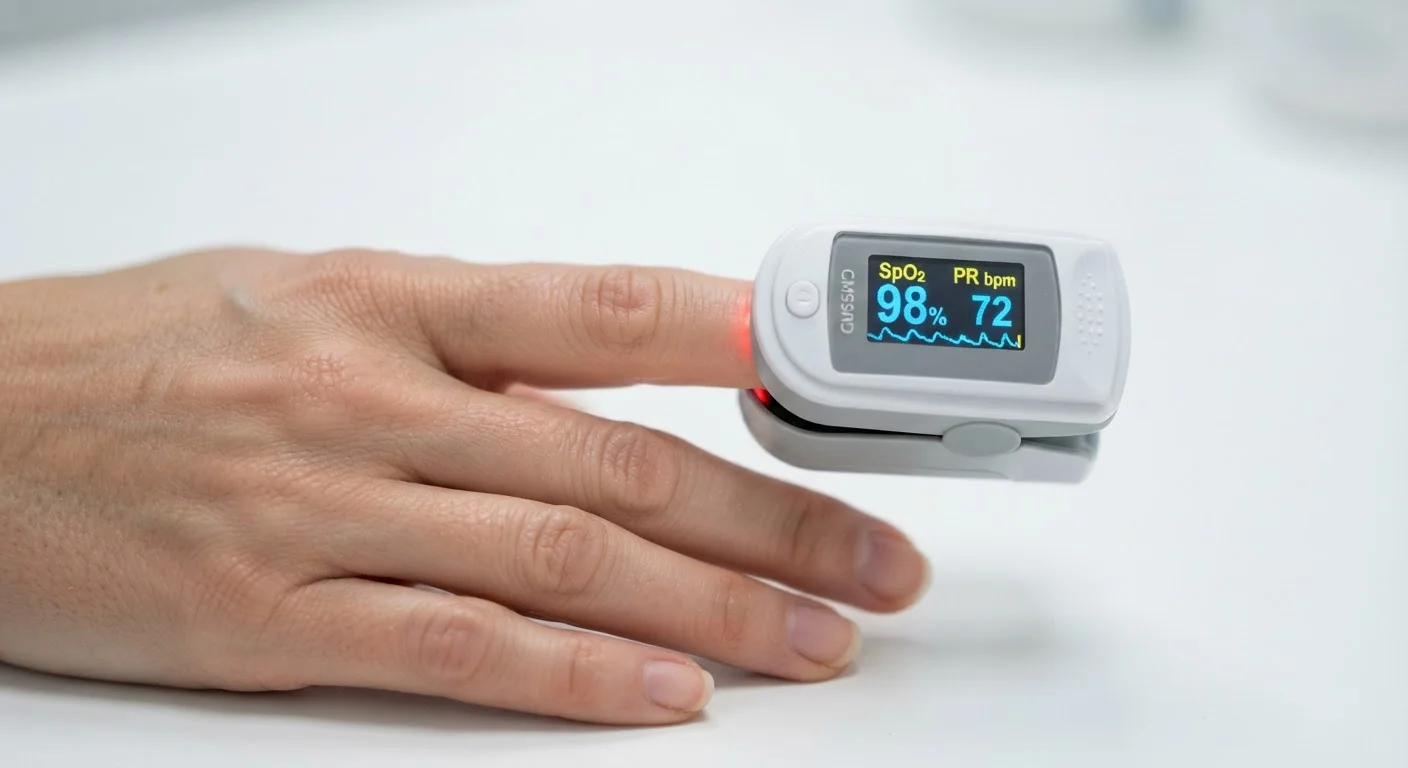
Oxygen saturation, displayed as SpO2, is a measure of how much of your blood's hemoglobin is carrying oxygen. It is expressed as a percentage, where 100% would mean every hemoglobin molecule is fully loaded with oxygen. A pulse oximeter estimates this value non-invasively by shining light through your fingertip.
SpO2 measured by a pulse oximeter is an indirect estimate; direct arterial blood gas analysis (SaO2) is the clinical gold standard and can differ slightly from oximeter readings.
How a Pulse Oximeter Produces a Number
A pulse oximeter works by exploiting a simple physical fact: oxygenated hemoglobin and deoxygenated hemoglobin absorb light at different wavelengths. The device clips onto a fingertip and emits two beams of light — one red, one infrared — through the tissue. Sensors on the opposite side measure how much of each wavelength is absorbed with every pulse of blood. The device's software uses that ratio to calculate the percentage of hemoglobin currently bound to oxygen, displayed as SpO2.
The reading updates continuously, which is why the number on the screen fluctuates slightly with each heartbeat. Most consumer devices also display a pulse rate derived from the same signal. For a deeper look at the underlying physics, see how a clip on your finger measures oxygen in your blood.
“Pulse oximetry is a valuable screening tool, but clinicians must remember it is an estimate — not a direct measure of arterial oxygenation. Its limitations, particularly around skin pigmentation, must inform how we use it at the bedside and in the home.”
— American Thoracic Society, Professional medical society for respiratory and critical care medicine
Understanding the SpO2 Scale
SpO2 is reported on a scale from 0% to 100%, but in practice, meaningful clinical ranges fall into a narrow band. The table below summarizes how clinicians generally interpret SpO2 values in otherwise healthy adults:
| SpO2 Range | General Interpretation |
|---|---|
| 95%–100% | Normal for most healthy adults |
| 91%–94% | Mildly reduced; warrants monitoring and clinical context |
| 86%–90% | Moderately low; medical evaluation recommended |
| 85% or below | Severely low; seek emergency care |
It is important to recognize that these thresholds are general guides, not absolute rules. A person with chronic lung disease may have a baseline SpO2 that their clinician considers acceptable at a lower value than the typical 95%–100% range. Individual context always matters.
95%–100%
Normal SpO2 range for healthy adults
This range is widely cited in clinical guidelines, including those from the American Thoracic Society, as the expected baseline for individuals without respiratory or circulatory conditions.
90%
Threshold below which hypoxemia is considered significant
An SpO2 at or below 90% is a commonly referenced clinical threshold at which supplemental oxygen therapy is often considered, according to established respiratory care guidelines.
3%–4%
Potential SpO2 overestimation in darker skin tones
A 2020 study published in the New England Journal of Medicine found conventional pulse oximeters overestimated arterial oxygen saturation by approximately 3–4 percentage points in patients with darker skin tones compared to lighter-skinned patients.
Factors That Can Make Readings Less Reliable
Pulse oximeters are useful screening tools, but several factors are known to reduce their accuracy — and understanding these limitations is essential before relying on a reading.
- Skin tone: Research has documented that conventional pulse oximeters can overestimate SpO2 in people with darker skin tones, potentially masking low oxygen levels. The FDA has issued guidance acknowledging this limitation, and it remains an active area of clinical concern.
- Poor peripheral circulation: Cold hands, low blood pressure, or conditions like Raynaud's phenomenon reduce blood flow to the fingertip, making it harder for the device to detect a reliable signal.
- Movement: Even small finger movements during a reading introduce noise into the light signal, which can cause erratic or falsely low readings.
- Nail coverings: Dark nail polish, gel nails, and some acrylic nails interfere with light transmission. Always test on a bare fingertip when accuracy matters.
- Carbon monoxide poisoning: Carboxyhemoglobin (hemoglobin bound to carbon monoxide) is read by standard oximeters as oxygenated hemoglobin, so a dangerously poisoned person may display a normal-looking SpO2.
For a thorough review of accuracy caveats, pulse oximeter limitations worth knowing before incorporating one into routine health monitoring.
Improve Reliability With Simple Steps
Warm your hands before taking a reading to improve peripheral blood flow. Keep your hand still and at heart level during the measurement. Use a bare finger free of nail polish, and wait for the waveform display — if your device has one — to stabilize before recording the value.
Putting SpO2 in Context With Other Home Readings
SpO2 is one data point in a broader picture of cardiovascular and respiratory health. It tells you how well oxygen is being delivered to hemoglobin, but it says nothing about blood pressure, breathing efficiency, or how effectively oxygen is being used by your cells. Families managing chronic conditions often monitor multiple metrics simultaneously.
For example, someone managing heart failure may track both SpO2 and blood pressure at home. Understanding what each number means independently is important before drawing conclusions about their combined significance. Our guide to blood pressure monitor readings at home explains the systolic and diastolic values in equally plain terms.
Whenever you log multiple readings — whether for a clinical appointment or ongoing self-management — device accuracy and consistent technique matter. The home monitor accuracy checklist covers technique and environmental factors that apply to SpO2 and other home measurements.
This article is for general informational purposes only and does not constitute medical advice. Always consult a qualified healthcare professional regarding symptoms, diagnosis, or any health decisions, including the interpretation of SpO2 readings.